On this page
Why measurement fails by default
Creator marketing generates data in different places with different vocabularies. Instagram now reports views and accounts reached and has retired impressions as an organic term; YouTube counts an impression only when a thumbnail is shown for more than a second; X counts a view every time a logged-in user sees a post, author included. Costs live somewhere else again: invoices, gifted product, affiliate payouts, and software fees scattered across finance systems. Outcomes arrive last, partially, through whichever attribution you set up.
Nobody plans a bad measurement system. Teams start with a screenshot deck for one campaign, add a spreadsheet for the next, and two quarters later cannot say which creator delivers the best value, because the records do not exist. The fix is structural: decide what gets recorded, at which layer, before the next campaign starts.
The framework: creators, activities, costs, outcomes
Every measurement question resolves into four layers. The creator layer records who you selected to partner with and why, including their audience size, niche, and fit with the campaign. The activity layer records what happened: each piece of creator content, who posted it, on which platform, for which campaign, and how it performed over time. The cost layer records what it took: fees, product, commissions, amplification, and tools, attached to the specific activity or campaign they funded. The outcome layer records what it produced: engagements and reach as leading indicators, conversions and revenue as the destination.
The layers only pay off when they join. An engagement count is trivia until the cost of the post is divided by the engagements it earned, becoming cost per engagement. A conversion total is unaccountable until it maps back to campaigns and creators. Joined, the four layers answer the practical questions: which creator is most efficient, which platform earns its budget, and whether this quarter beat last.
Objectives and KPIs
Pick the primary KPI per campaign before launch, and let it follow the objective. Awareness campaigns are judged on reach, views, and CPM. Engagement campaigns are judged on engagement volume, engagement rate, and CPE. Conversion campaigns are judged on attributed conversions, revenue, and ROI.
Awareness
- Primary KPI
- Views / reach
- Efficiency metric
- CPM
- Typical pitfall
- Comparing non-deduplicated views across platforms
Engagement
- Primary KPI
- Engagements
- Efficiency metric
- CPE
- Typical pitfall
- Ignoring cost, so big creators always look best
Conversion
- Primary KPI
- Attributed revenue
- Efficiency metric
- ROI / ROAS
- Typical pitfall
- Attribution method chosen after the fact
| Objective | Primary KPI | Efficiency metric | Typical pitfall |
|---|---|---|---|
| Awareness | Views / reach | CPM | Comparing non-deduplicated views across platforms |
| Engagement | Engagements | CPE | Ignoring cost, so big creators always look best |
| Conversion | Attributed revenue | ROI / ROAS | Attribution method chosen after the fact |
Core metrics, as the platforms define them
Cross-platform comparisons quietly break when the same word means different things. These definitions come from each platform’s official documentation, checked on 25 July 2026.
Instagram defines views as the number of times your content was played or displayed, and accounts reached as unique accounts that saw your content at least once; reach is explicitly estimated. YouTube counts impressions only when a thumbnail is shown for more than one second and at least half visible, and defines watch time as hours viewers spent watching. TikTok’s ads documentation counts a video view at first play, excluding replays, and defines reach as unique accounts exposed, noting it is sampled and estimated. LinkedIn counts an impression when a post is at least half on screen for 300 milliseconds or more, and defines engagement rate as interactions divided by impressions. X’s view count increments every time any logged-in user views a post, not deduplicated, including the author. Reddit documents post views in one line, with no deduplication statement at all.
The practical consequences: never sum views across platforms as if they were one unit; compare each platform against its own history instead. And treat deduplicated metrics (accounts reached, TikTok reach) and non-deduplicated ones (views, impressions) as different species. For outcomes, note that Google Analytics 4 calls the events you mark as business-critical key events, distinct from Google Ads conversions.
CPE = Total cost ÷ Engagements
CPM = Total cost ÷ Impressions × 1,000
Cost efficiency metrics are where the activity and cost layers meet, and they are the fairest way to compare creators of different sizes: a nano creator with 2,000 engagements on a $200 gifted post beats a celebrity with 50,000 engagements on a $20,000 fee, and CPE is the number that shows it. The full revenue math lives in the ROI guide.
Attribution: the honest layer
No single attribution method tells the truth alone. Links and codes are precise but miss everyone who saw creator content and bought later without clicking. Self-reported attribution, the how-did-you-hear-about-us question at checkout, catches that delayed influence but leans on customer memory. Platform-reported conversions each use their own rules. The workable posture is to run link or code attribution and HDYHAU together, compare them, and state the method next to every number you publish. The ROI guide covers the failure modes of each method in detail.
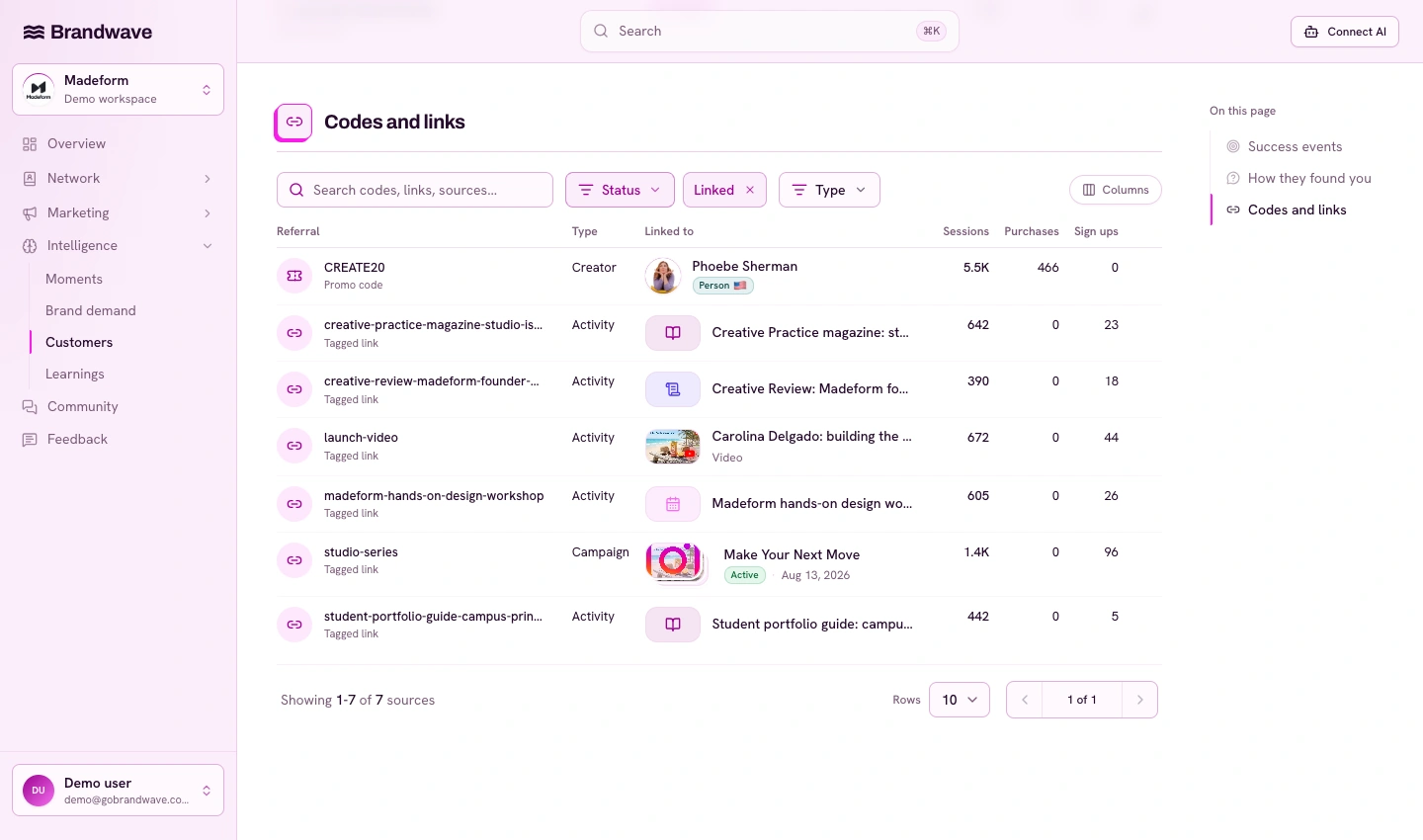
The reporting workflow
- Log activities as they go live: creator, platform, campaign, content link, and the costs attached.
- Let performance accumulate continuously; engagement builds for weeks and a day-three screenshot undercounts it.
- Review weekly at the campaign level: activities delivered, engagement trend, spend against plan.
- Report monthly or per campaign to leadership: KPIs against objectives, CPE and CPM against your own history, conversions with the attribution method named.
- Keep everything: historical comparison is what turns a report into a decision about next quarter’s budget.
What the report should look like, board-ready dashboard layouts, and a downloadable template are covered in the dashboard guide.
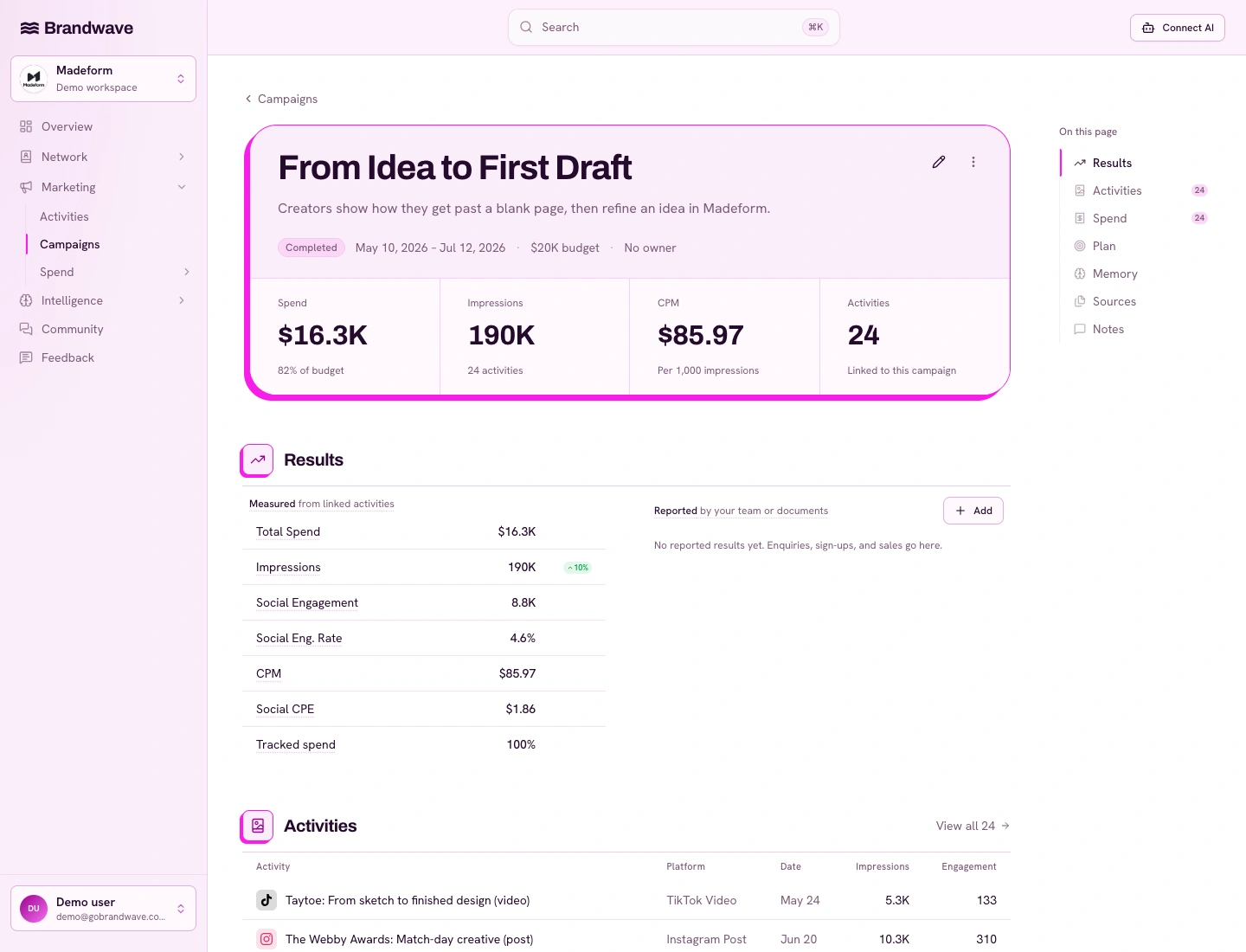
Choosing tools
Spreadsheets are the right starting point and the wrong destination. They fail at exactly the two things that make measurement compound: continuous performance collection and history you can query. When you evaluate software, the questions that matter are which platforms it tracks and whether it needs account ownership, whether costs attach to activities, whether history is kept and comparable, and whether data leaves the tool through an API when you need it elsewhere.
Be equally clear about product categories. Client-reporting suites such as AgencyAnalytics report on accounts your clients own and connect; they do not track third-party creators, which is why creator teams outgrow them (see our alternatives roundup). Program-execution platforms such as GRIN bundle reporting with discovery, CRM, and payments at a correspondingly higher price (see the GRIN pricing guide). Brandwave sits in the measurement category: it tracks creators, content, activities, campaigns, costs, and history across Instagram, YouTube, TikTok, X, LinkedIn, and Reddit. It is free to start, with paid plans from US$139 per month, and includes an HTTP API and an MCP server.
Go deeper
ROI and formulas
Attribution setup, the ROI formula, honest cost accounting, and worked examples.
Reporting and dashboards
Dashboard examples for executives, campaigns, creators, and costs, plus a downloadable reporting template.
Tool comparisons
Sourced, independent buyer guides for the platforms teams evaluate alongside Brandwave.
Brandwave
The measurement platform behind this framework: plans, docs, and the API.
FAQ
Sources
- Meta Business Help Center: About Instagram insights (views, accounts reached) (facebook.com)
- YouTube Help: Check your YouTube impressions and watch time (support.google.com)
- TikTok Ads Manager: Video play metrics (views counted at first play, replays excluded) (ads.tiktok.com)
- TikTok Ads Manager: About the Reach metric (unique, sampled, estimated) (ads.tiktok.com)
- LinkedIn Help: Content analytics for your LinkedIn Page (impressions, engagement rate) (linkedin.com)
- LinkedIn Help: Post analytics for your content (impressions, members reached) (linkedin.com)
- X Help Center: View counts (non-deduplicated, logged-in views) (help.x.com)
- Reddit Help: Post and comment insights (views definition) (support.reddithelp.com)
- Google Analytics Help: About key events (key events vs Google Ads conversions) (support.google.com)
Get the next article by email
Drop us your email and we'll let you know when we publish a new article.
By continuing you'll get an email for each new article and occasional product news from Brandwave. Unsubscribe any time. Privacy