On this page
The direct answer
As of 25 July 2026, GRIN’s official pricing page lists five monthly plans: Free at $0, Starter at $200, Growth at $500, Scale at $1,000, and Complete at $1,500. Each includes a monthly bundle of Gia credits, from 200 on Free to 30,000 on Complete. GRIN Classic, the hands-on creator CRM and campaign workspace, comes with Growth and above, capped at 100, 250, and 500 active creators respectively.
Plans are month-to-month with no annual contract, no minimum commitment, and no required sales call. Free does not require a credit card and has no trial clock whereas paid plans require a card up front. This is a recent change from GRIN’s older quote-based sales model.
Free
- Monthly price
- $0
- Gia credits
- 200/month
- GRIN Classic
- Not included
- Credit overage
- Not available; billable work pauses
Starter
- Monthly price
- $200
- Gia credits
- 2,000/month
- GRIN Classic
- Not included
- Credit overage
- Metered under a cap you set
Growth
- Monthly price
- $500
- Gia credits
- 7,500/month
- GRIN Classic
- Included, up to 100 active creators
- Credit overage
- Metered under a cap you set
Scale
- Monthly price
- $1,000
- Gia credits
- 20,000/month
- GRIN Classic
- Included, up to 250 active creators
- Credit overage
- Metered under a cap you set
Complete
- Monthly price
- $1,500
- Gia credits
- 30,000/month
- GRIN Classic
- Included, up to 500 active creators
- Credit overage
- Metered under a cap you set
| Plan | Monthly price | Gia credits | GRIN Classic | Credit overage |
|---|---|---|---|---|
| Free | $0 | 200/month | Not included | Not available; billable work pauses |
| Starter | $200 | 2,000/month | Not included | Metered under a cap you set |
| Growth | $500 | 7,500/month | Included, up to 100 active creators | Metered under a cap you set |
| Scale | $1,000 | 20,000/month | Included, up to 250 active creators | Metered under a cap you set |
| Complete | $1,500 | 30,000/month | Included, up to 500 active creators | Metered under a cap you set |
How the credit model works
GRIN prices the work its AI assistant does, not seats. Credits are consumed in effort tiers: sending outreach and messages is light; finding, scoring, and shortlisting creators is medium; building personas, running reports and analysis, gifting workflows, and setting up campaigns are heavy. Gia itself has no active-creator limit; only the Classic workspace carries per-plan creator caps.
A meaningful set of actions never uses credits: viewing and filtering, configuration, manual messages you send yourself, previews, affiliate link and code generation, GMV tracking, and migration from a CSV or a competitor platform. GRIN also states there is no take rate or transaction fee on affiliate GMV.
If you exceed your monthly bundle on a paid plan, Gia keeps running at one flat overage rate, the same on every paid plan, under a hard cap you set; GRIN says you are never billed above that cap and warns you as you approach your included credits. The actual dollar rate per overage credit is not disclosed on the page. Included credits do not roll over, but purchased overage credits do. Upgrades are prorated mid-cycle, and on cancellation your plan runs to the end of the billing cycle with your CRM, links, and data left in place.
That makes usage a material part of the long-term price. A team that leans more heavily on Gia as its program grows can move into higher tiers or add overage spend even if its number of users stays the same. The hard cap prevents an unlimited bill, but the unpublished overage rate means you cannot tell from the pricing page when the credit model becomes more expensive than a fixed-price alternative.
What GRIN Classic includes
GRIN Classic is the established creator management product: discovery, relationship management, payments (including 1099 handling), content management, social listening, reporting and analytics, and integrations. The product page names Gmail, Outlook, and Klaviyo for email, Shopify for ecommerce (shipping products to creators, discount codes, commission on sales), and Slack, DocuSign, and PayPal for workflow. Growth, Scale, and Complete get identical workspace allowances except for the active-creator cap.
Active creators
- 100 / 250 / 500
CRM contacts and prospects
- Unlimited
User logins
- 5
Landing pages
- 10
Email templates and sequences
- 150 templates, 10 sequences
Campaign activations
- 12
Daily creator searches
- 150
Shopify integration
- Included
| Workspace allowance | Growth / Scale / Complete |
|---|---|
| Active creators | 100 / 250 / 500 |
| CRM contacts and prospects | Unlimited |
| User logins | 5 |
| Landing pages | 10 |
| Email templates and sequences | 150 templates, 10 sequences |
| Campaign activations | 12 |
| Daily creator searches | 150 |
| Shopify integration | Included |
Extra costs and undisclosed items
- The flat overage rate per credit is not published. You control exposure with a hard cap, but you cannot model the exact cost in advance.
- GRIN lists no onboarding or setup fees on the pricing page. A professional services agreement exists in its legal footer, with no public pricing.
- No annual billing discount is mentioned; plans appear monthly-only.
- GRIN’s official FAQ says Creator Search covers TikTok and YouTube, while creator activation supports Facebook, Instagram, TikTok, Twitter, Pinterest, YouTube, and Twitch.
- Third-party listings still show stale figures, such as a $999/month starting price with no free trial on Capterra. Treat grin.co/pricing as the authoritative source.
Realistic cost scenarios
Three scenarios show how the tiers play out in practice, using only published numbers. A team piloting AI-assisted creator work can run on Free indefinitely: 200 credits per month, hard stop, no card. A small program that wants the CRM workspace needs Growth at $500 per month, because Starter has no Classic access; that buys 7,500 credits and up to 100 active creators. A larger program managing a few hundred creators lands on Scale or Complete at $1,000 to $1,500 per month, i.e. $12,000 to $18,000 per year plus any overage spend under the cap it sets.
The gap worth noticing is between Starter and Growth: $200 per month buys AI assistance only, and the jump to a managed workspace costs $500 per month. If what you mainly need is measurement and reporting on creator performance rather than a CRM and outreach engine, that price jump might warrant assessing alternatives. Usage-based credits can widen the difference over time because heavier Gia use may add overage spend or push the team into a higher plan.
What customers say about GRIN pricing
GRIN rates 4.5 out of 5 from 483 reviews on G2 and 4.7 out of 5 from 147 reviews on Capterra, with Capterra’s value-for-money score at 4.5. Reviewers praise ease of use and streamlined creator management. On cost, the recurring themes are that pricing adds up, with one 2026 reviewer describing being billed for everything, and that the creator database quality requires extra effort, a point G2’s own review summary flags. G2’s pricing insights report a typical one-month implementation and an average discount of 9%.
Negative reviews mainly concern lock-in contracts. However, these reviews predate GRIN’s shift to its current pricing model, which explicitly advertises no annual contracts or minimum commitments, so this issue appears to have been addressed.
GRIN vs Brandwave
GRIN and Brandwave overlap on reporting but are built for different jobs. GRIN is an operations platform for ecommerce creator programs: discovery, CRM, outreach, payments, and Shopify workflows, with reporting attached. Brandwave is a measurement and management platform: it tracks creator content, activities, campaigns, costs, and historical performance across Instagram, YouTube, TikTok, X, LinkedIn, and Reddit, and exposes the same data through a web dashboard, HTTP API, and MCP access for AI assistants.
On price, Brandwave is free to start, and its paid plans start at US$139 per month and are published on the pricing page. Brandwave does not use per-seat pricing, so you can invite the team without paying for each additional login. If your need is organizing creator work and proving performance and cost efficiency, the comparison is a free plan or a fixed plan from US$139 per month against the $500 per month GRIN plan that first includes its workspace, and Gia overages can raise GRIN’s cost as usage grows.
Primary job
- Brandwave
- Creator marketing measurement and intelligence
- GRIN
- Creator program operations for ecommerce
Entry price
- Brandwave
- Free; paid from US$139/month, self-serve
- GRIN
- Free (AI only); workspace from $500/month
Pricing basis
- Brandwave
- Fixed plan limits, with no per-seat pricing
- GRIN
- Monthly AI credits plus creator caps
Contract
- Brandwave
- Monthly, no minimum commitment
- GRIN
- Month-to-month, no annual contract
Platform coverage
- Brandwave
- Instagram, YouTube, TikTok, X, LinkedIn, Reddit
- GRIN
- Activation: Facebook, Instagram, TikTok, Twitter, Pinterest, YouTube, Twitch
Discovery, CRM, payments
- Brandwave
- Not offered
- GRIN
- Included from Growth up
API and agent access
- Brandwave
- HTTP API and MCP server
- GRIN
- Integrations listed; no public API pricing
| Feature | Brandwave | GRIN |
|---|---|---|
| Primary job | Creator marketing measurement and intelligence | Creator program operations for ecommerce |
| Entry price | Free; paid from US$139/month, self-serve | Free (AI only); workspace from $500/month |
| Pricing basis | Fixed plan limits, with no per-seat pricing | Monthly AI credits plus creator caps |
| Contract | Monthly, no minimum commitment | Month-to-month, no annual contract |
| Platform coverage | Instagram, YouTube, TikTok, X, LinkedIn, Reddit | Activation: Facebook, Instagram, TikTok, Twitter, Pinterest, YouTube, Twitch |
| Discovery, CRM, payments | Not offered | Included from Growth up |
| API and agent access | HTTP API and MCP server | Integrations listed; no public API pricing |
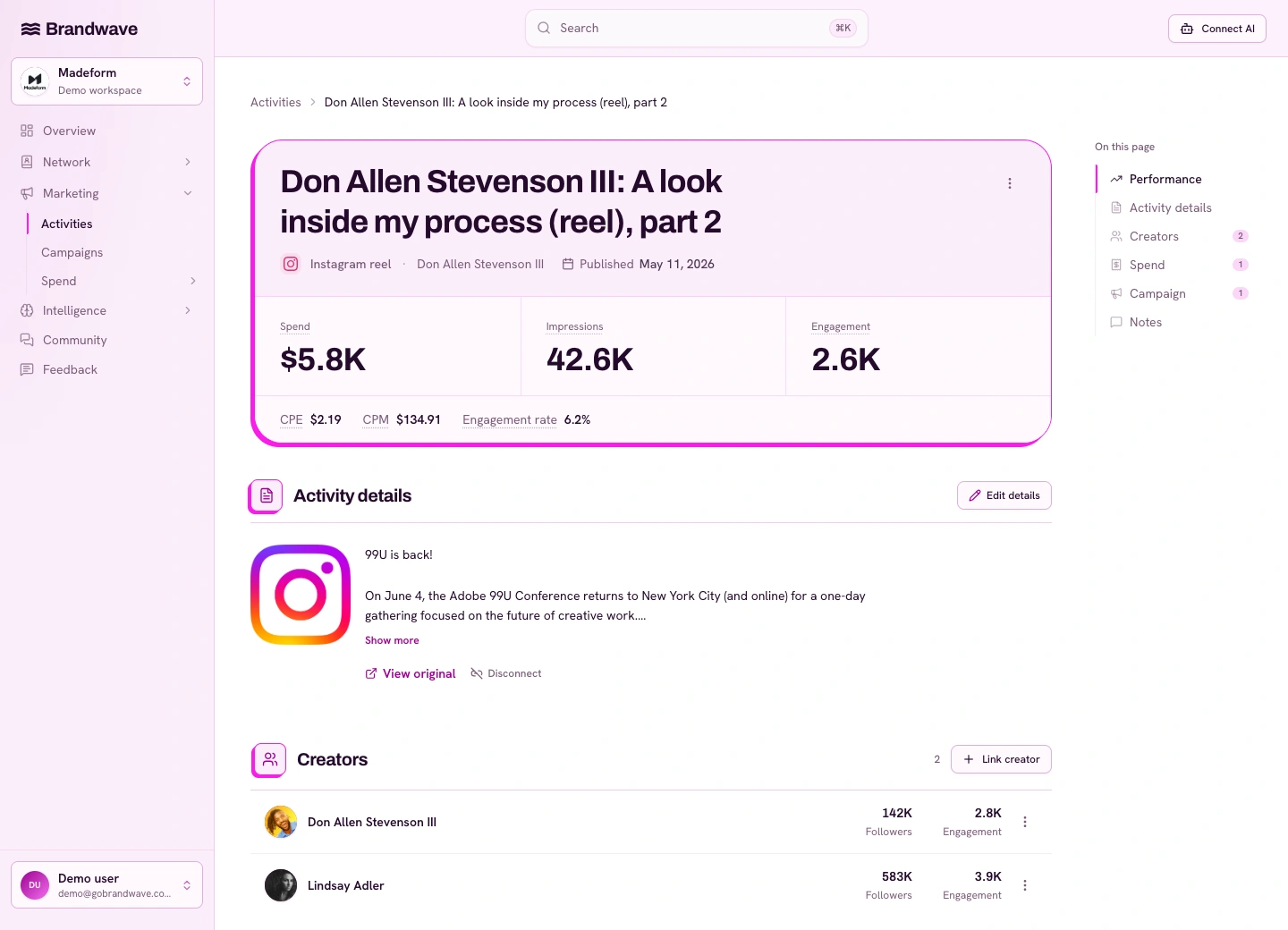
Alternatives to GRIN
For a full buyer comparison organized by measurement, campaign operations, ecommerce, creator vetting, and enterprise needs, see our dedicated guide to the best GRIN alternatives. The shorter list below highlights the most direct options from a pricing perspective.
Brandwave
- Best for
- Best for: Measurement-first teams that need to prove creator ROI
- Starting price:
- Free; paid from US$139/month
Keeps creators, content, campaigns, costs, and history organized across six platforms with a free plan, paid plans from US$139 per month and no per-seat pricing. No discovery or CRM; pairs well with whatever execution stack you already use. See how we approach measurement.
Modash
- Best for
- Best for: Discovery plus tracking with published pricing
- Starting price:
- From $299/month
Essentials from $299 per month on annual billing ($399 monthly), Performance from $599, Enterprise from $14,700 per year. 14-day free trial without a card, no setup fees, and creator tracking that does not require creator opt-in. Payments carry a 0% fee up to $10K per year on Performance annual.
Upfluence
- Best for
- Best for: Teams comfortable with quoted, modular pricing
- Starting price:
- Custom, 12-month minimum
Modular, custom-quoted plans with a fixed platform fee and no percentage of sales. The minimum contract is 12 months, and trials come after a sales call, so it suits teams that already know their requirements.
Aspire
- Best for
- Best for: Larger brands that accept demo-gated pricing
- Starting price:
- Not published
Positioned around large ecommerce creator programs and trusted by 800+ brands by its own count. No public pricing: the plans page is a demo booking form, so budget planning requires a sales process.
Verdict
GRIN’s move to public, month-to-month pricing removes its two most-criticized commercial practices: opaque quotes and annual lock-ins. The free tier is genuinely free, and the credit model with a user-set hard cap keeps spend bounded, though the undisclosed overage rate makes precise budgeting impossible and can raise the effective price as usage grows. For ecommerce teams that want operations and measurement in one place and can justify $500 or more per month, it is a credible default.
For teams whose actual problem is measurement, paying for a CRM, outreach engine, and payments system they will not use is the expensive path. Start by writing down which job you are hiring for; if it is proving performance, a dedicated measurement layer that is free to start leaves budget for the creators themselves. Our ROI guide is a practical place to start.
FAQ
Sources
- GRIN pricing page (plans, credits, contract and trial terms) (grin.co)
- GRIN product page (modules and integrations) (grin.co)
- GRIN FAQ (supported social platforms) (grin.co)
- G2 reviews for GRIN (4.5/5, 483 reviews, seen 25 July 2026) (g2.com)
- Capterra listing for GRIN (4.7/5, 147 reviews, stale starting-price data) (capterra.com)
- Reddit thread on GRIN sales process (r/influencermarketing, 2024) (reddit.com)
- Modash pricing page (modash.io)
- Upfluence pricing page (upfluence.com)
- Aspire plans page (demo-gated) (aspire.io)
Get the next article by email
Drop us your email and we'll let you know when we publish a new article.
By continuing you'll get an email for each new article and occasional product news from Brandwave. Unsubscribe any time. Privacy