On this page
The short verdict
Choose Stack Influence if you sell physical products on Amazon or TikTok Shop and want volume micro-influencer promotions without managing creators yourself. Its pricing page lists a $30 average flat fee per creator, $0 in added monthly fees, and full usage rights to the content creators produce. Brand reviews on G2 average 4.5 out of 5 across 36 reviews.
Choose Brandwave if you run creator partnerships in-house and need an easier way to organize the program and prove that the spend works. Brandwave keeps creators, campaigns, content, costs, and performance together across Instagram, YouTube, TikTok, X, LinkedIn, and Reddit, free to start, with paid plans from US$139 per month. Pricing is not per seat, so you can invite the team without paying for another login each time. Brandwave does not recruit creators. It shows what Stack Influence campaigns did next to your sales and conversions.
Many brands will use both kinds of tool. An execution platform to get content made, and a measurement layer to judge what that content achieved.
What Stack Influence does
Stack Influence describes itself as a micro-influencer platform powered by AI management software and a network of vetted micro-influencers, focused on the Amazon marketplace, Shopify, Tiktok, and Meta ads. The model is product seeding with reimbursement: creators buy your product from your store and are reimbursed after their post is verified. You never ship inventory yourself and you keep full usage rights to the resulting photos and videos.
The platform handles creator matching, outreach, vetting, and campaign management against goals you set. You then track creator statuses, live links, and performance in a dashboard, download the content, and export reports. Top performers can be graduated into longer-term ambassador and affiliate arrangements with tracking links and commissions.
- Managed product seeding: creators purchase your product and are reimbursed after a verified post
- Full usage rights to creator photos and videos, included rather than sold as an add-on
- AI-driven creator matching using demographic, psychographic, and geographic data
- Creator whitelisting: partnership and Spark code permissions for running ads from creator profiles
- Ambassador and affiliate workflows with tracking links and commission structures
- Campaign dashboard with live links, creator statuses, report exports, and UGC downloads
Stack Influence pricing
Stack Influence does not publish a plan-by-plan price list. Its advertises an average price per creator of $30 as a flat fee, and $0 in added monthly fees. The same page contrasts this with competitors it lists at $500 per creator plus platform fees, or monthly platform charges from $499 to $6,000. It also advertises a 50% saving at larger scale, without defining the volume threshold.
Several commercial details are not publicly disclosed such as minimum spend, minimum creator count, contract length, and billing mechanics. To get started you have to book a demo, so expect a sales conversation before you see a quote. A G2 reviewer described the commercial model as pay-as-you-go credits, and another reported a $15 minimum product price, but neither detail appears on official pages.
Average price per creator
- $30 flat fee
Added monthly fees
- $0
Campaign management
- Included, described as 100% managed at no cost
UGC usage rights
- Included, competitors listed as charging extra fees
Volume discount
- 50% saving at larger scale, threshold undefined
Minimum spend and contract terms
- Not published; sales are demo-led
| Pricing element | What Stack Influence publishes |
|---|---|
| Average price per creator | $30 flat fee |
| Added monthly fees | $0 |
| Campaign management | Included, described as 100% managed at no cost |
| UGC usage rights | Included, competitors listed as charging extra fees |
| Volume discount | 50% saving at larger scale, threshold undefined |
| Minimum spend and contract terms | Not published; sales are demo-led |
What customers say
On the brand side, Stack Influence holds 4.5 out of 5 from 36 reviews on G2, with 93% of reviewers giving four stars or more. The recurring positives are faster Amazon sales velocity and review growth, quick onboarding, automation that saves time compared with manual outreach, responsive project managers, and reusable UGC as a byproduct of campaigns.
Reviewers also raise inconsistent creator and content quality: several describe wide variance in follower counts and content effort, and ask for better vetting or more pre-campaign visibility into who they will get. One reviewer reported that the platform could not track sales from its influencers, leaving conversion impact unclear. A separate one-star review described creators returning products after reimbursement without the platform flagging it. G2 tags cost as a concern in five reviews.
On the creator side, Stack Influence holds a 4.6 TrustScore on Trustpilot from 542 reviews. Creators praise fast reimbursement after posting and the portfolio value for beginners. Critical reviews describe payment disputes handled by automated support loops, and compensation that amounts to product value while shipping costs sit with the creator. Trustpilot also notes the company asks customers for reviews and has not replied to negative ones.
Strengths and limitations
Pros
- Simple pricing structure: $30 average flat fee per creator with $0 monthly fees
- Reimbursement-based seeding means no inventory loss and no manual shipping
- Full-rights UGC included in the price
- Strong ratings on both sides: 4.5/5 on G2 (brands) and 4.6 on Trustpilot (creators)
- Fully managed workflow that reviewers say saves significant time
Cons
- Several reviewers report inconsistent creator and content quality
- A reviewer reported no direct sales attribution, so conversion impact is hard to prove
- One brand reported product-return abuse that the platform did not flag
- No public rate card; minimum spend and contract terms require a sales call
- Creator pay is essentially product reimbursement, which drives some creator-side disputes
Stack Influence vs Brandwave
Stack Influence and Brandwave solve fundamentally different aspects of creator marketing. Stack Influence executes campaigns: it finds creators, seeds product, and collects content. Brandwave is an orchestration and measurement platform: it gives your team one place to organize creators, campaigns, content, and costs, track performance across six social platforms, and keep the history needed to compare periods and prove impact.
The practical question is which job you need done. If you have no creator program and want one switched on for you, Stack Influence solves that. If you already work with creators and your problem is keeping the program organized, replacing scattered data, understanding cost efficiency, and answering leadership when they ask whether any of it works, that is the job Brandwave is built for. Brandwave does not charge per seat, so the people running and reporting on the program can work from the same record.
Primary job
- Brandwave
- Organize and measure an in-house creator program
- Stack Influence
- Run managed micro-influencer seeding campaigns
Platform coverage
- Brandwave
- Instagram, YouTube, TikTok, X, LinkedIn, Reddit
- Stack Influence
- Amazon, Tiktok, Shopify, Meta
Creator sourcing and outreach
- Brandwave
- Not offered
- Stack Influence
- Included and automated
Campaign cost and CPE tracking
- Brandwave
- Built in, across campaigns and creators
- Stack Influence
- Performance reporting included
Historical performance data
- Brandwave
- Kept and comparable across periods
- Stack Influence
- Not documented on official pages
Pricing model
- Brandwave
- Free plan; paid plans from US$139/month, self-serve, no per-seat pricing
- Stack Influence
- $30 average per creator, demo-led sales
API and integrations
- Brandwave
- Full HTTP API and MCP server for your AI agents
- Stack Influence
- Manual report exports available
| Feature | Brandwave | Stack Influence |
|---|---|---|
| Primary job | Organize and measure an in-house creator program | Run managed micro-influencer seeding campaigns |
| Platform coverage | Instagram, YouTube, TikTok, X, LinkedIn, Reddit | Amazon, Tiktok, Shopify, Meta |
| Creator sourcing and outreach | Not offered | Included and automated |
| Campaign cost and CPE tracking | Built in, across campaigns and creators | Performance reporting included |
| Historical performance data | Kept and comparable across periods | Not documented on official pages |
| Pricing model | Free plan; paid plans from US$139/month, self-serve, no per-seat pricing | $30 average per creator, demo-led sales |
| API and integrations | Full HTTP API and MCP server for your AI agents | Manual report exports available |
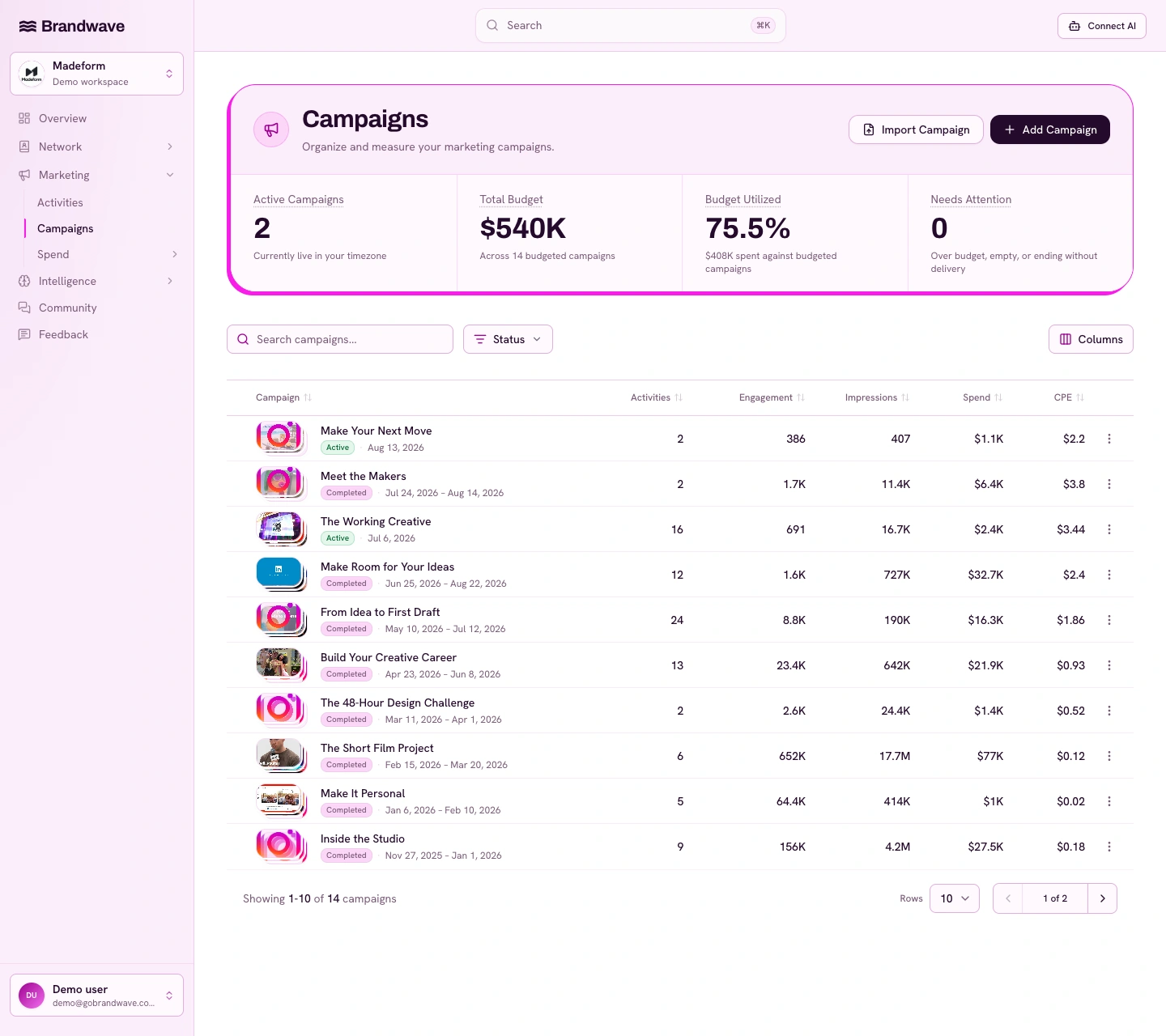
Alternatives worth considering
If Stack Influence does not fit, the right alternative depends on which part of the job you are hiring for. Verified starting prices as of 25 July 2026:
Brandwave
- Best for
- Best for: Measuring an existing creator program
- Starting price:
- Free; paid from US$139/month
Keeps creators, content, activities, campaigns, and costs organized across Instagram, YouTube, TikTok, X, LinkedIn, and Reddit, with CPE and CPM efficiency metrics and full performance history. It is free to start, with self-serve paid plans from US$139 per month and no per-seat charges, plus an HTTP API and an MCP server. It does not source creators; your team runs its own campaigns and uses Brandwave to manage and measure them. See Brandwave pricing.
GRIN
- Best for
- Best for: Ecommerce teams running creator programs in-house
- Starting price:
- Free, paid from $200/month
A creator management platform with discovery, CRM, payments, content management, and reporting, plus a Shopify integration. GRIN moved to public month-to-month pricing in its current model: a free tier, then credit-based plans from $200 per month. We break the tiers down in our GRIN pricing guide.
Modash
- Best for
- Best for: In-house discovery, tracking, and creator payments
- Starting price:
- From $299/month
Creator discovery, campaign content tracking without creator opt-in, outreach, and payments. Essentials starts at $299 per month with annual billing ($399 billed monthly) with a 14-day free trial and no setup fees.
HypeAuditor
- Best for
- Best for: Creator vetting and audience-quality analysis at scale
- Starting price:
- From $299/month, billed annually
A 205M-plus creator database with audience quality scores, fraud and brand-safety checks, discovery, and campaign tracking. Basic starts at $299 per month billed annually; higher tiers are custom and all plans go through sales.
Who should choose which
- Choose Stack Influence if you sell on Amazon or TikTok Shop, want hands-off micro-influencer volume, and can accept variable content quality in exchange for a low per-creator cost.
- Choose Brandwave if you already run creator partnerships and need to keep the program organized as well as prove performance: one shared workspace for your team, unified tracking across six platforms, cost and efficiency metrics, and history you can put in front of leadership. Pricing is not per seat. Start with our guide to influencer marketing measurement.
- Choose GRIN or Modash if you want to run the whole program in-house, including discovery, relationships, and payments.
- Choose HypeAuditor if creator vetting and audience quality are your main concern.
FAQ
Sources
- Stack Influence pricing page (pricing table and fee claims) (stackinfluence.com)
- Stack Influence platform overview (product seeding, UGC rights, whitelisting) (stackinfluence.com)
- Stack Influence homepage (AI matching, product seeding flow) (stackinfluence.com)
- G2 reviews for Stack Influence (4.5/5, 36 reviews, seen 25 July 2026) (g2.com)
- Trustpilot reviews for Stack Influence (4.6, 542 reviews, seen 25 July 2026) (trustpilot.com)
- GRIN pricing page (grin.co)
- Modash pricing page (modash.io)
- HypeAuditor pricing page (hypeauditor.com)
Get the next article by email
Drop us your email and we'll let you know when we publish a new article.
By continuing you'll get an email for each new article and occasional product news from Brandwave. Unsubscribe any time. Privacy