On this page
- Download the campaign brief and review templates
- Start with the business result, not the deliverables
- What should a marketing campaign brief include?
- Agree on the measurement plan before anything goes live
- What events taught me about choosing the right goal
- Change the plan without rewriting the original goal
- Use checkpoints to decide what to change
- Cut repeated context, not the information needed to decide
- Turn the post-campaign review into the next brief
- FAQ
Download the campaign brief and review templates
Use the campaign brief before launching and the review template afterward. Both are CSV files you can open in Excel or Google Sheets. Fill in your answers, add links to supporting documents, and keep everything organized under the same campaign name.
These documents help with planning, not tracking tasks or attribution. To track activities and costs during your campaign, use the marketing campaign tracker template too.
Marketing campaign brief template (CSV)
This editable campaign planning template includes your business objective, audience, budget, measurement, tracking checks, and review decisions.
Post-campaign review template (CSV)
Compare your results to the original brief, note any changes, and use what you learned to set clear requirements for your next campaign.
Start with the business result, not the deliverables
If you say, “We need some ads and a landing page,” you’re only describing the tasks. That doesn’t tell your team what those things should achieve.
If the campaign is meant to generate leads, explain what a useful lead looks like. Do you want people who understand the product, fit the customer profile and are ready for a budget conversation? Does sales need them to know something specific before a meeting?
These details shape the message, offer, form, and follow-up. They also help your colleagues spot any mismatch before you spend money.
For example, an illustrative brief might say: “Generate inquiries from businesses that fit our customer profile and are ready to discuss implementation and budget. Use the campaign to test whether this audience understands the offer well enough to progress to a sales conversation.”
Now the creative team knows what to say, sales knows what to expect, and the review has a clear business question to answer. The next step might be to repeat the campaign, invest more in this audience, or change the offer.
What should a marketing campaign brief include?
The brief doesn’t need to be long. It just needs to include decisions others might have to guess. Use this structure and add links to detailed budgets or measurement plans if needed.
Business objective and decision
- The result you want, how it supports a business priority, and what decision this campaign should help you make.
Audience and desired response
- Who you want to reach, what they need to understand, and what you want them to do next.
Hypothesis and message
- Why you believe this audience will respond to this offer, plus the main message and supporting evidence.
Channels and deliverables
- What each channel is meant to do and what needs to be produced. Separate introducing the offer from closing the sale.
Budget, timing and quality
- The spending limit, included costs, launch and end dates, production expectations and any trade-off between speed and polish.
Baseline and expected outcome
- The starting position, comparison period, primary success measure and target. State when the result should reasonably be visible.
Measurement and tracking
- Metric definitions, data sources, collection method, known gaps and the prelaunch tracking check.
Owners and approvals
- Who delivers the work, approves it, checks the evidence and makes decisions during the campaign.
Assumptions and risks
- What must be true for the plan to work, what is uncertain and what you will do if an important assumption fails.
Checkpoints and review
- When you will review progress, what could trigger a change, and where the final results and lessons will live.
| Field | What to write |
|---|---|
| Business objective and decision | The result you want, how it supports a business priority, and what decision this campaign should help you make. |
| Audience and desired response | Who you want to reach, what they need to understand, and what you want them to do next. |
| Hypothesis and message | Why you believe this audience will respond to this offer, plus the main message and supporting evidence. |
| Channels and deliverables | What each channel is meant to do and what needs to be produced. Separate introducing the offer from closing the sale. |
| Budget, timing and quality | The spending limit, included costs, launch and end dates, production expectations and any trade-off between speed and polish. |
| Baseline and expected outcome | The starting position, comparison period, primary success measure and target. State when the result should reasonably be visible. |
| Measurement and tracking | Metric definitions, data sources, collection method, known gaps and the prelaunch tracking check. |
| Owners and approvals | Who delivers the work, approves it, checks the evidence and makes decisions during the campaign. |
| Assumptions and risks | What must be true for the plan to work, what is uncertain and what you will do if an important assumption fails. |
| Checkpoints and review | When you will review progress, what could trigger a change, and where the final results and lessons will live. |
For larger campaigns, a RASCI chart can clarify who is responsible, accountable, supporting, consulted, and informed. In a small team, just naming owners next to each decision might be enough. But remember, assigning someone to measurement is not the same as agreeing on what they’ll measure.
Agree on the measurement plan before anything goes live
Before launching, decide what you’ll want to know later. Then talk to the people who can help collect that information, such as your agency, data team, sales team, or the person who manages your website.
You might need campaign parameters on links, a new event in Google Tag Manager or a way to identify campaign leads in your customer system. Google’s campaign URL guidance explains how UTM parameters identify referring campaigns. Our promo code and UTM guide covers how to use those signals in campaign reporting.
Test the process before launching. Click a tagged link, complete the action, and check that the right record appears where you expect to review it. Having a tag in a setup screen is not the same as seeing a usable result in your report.
The technical detail can live in a linked measurement plan. The campaign brief should still name the measures, the owner and where to find that plan. It should also say whether tracking has been checked.
If your campaign should generate qualified leads, missing qualification data is a real problem. Fix it or agree on another way to collect it before launching. Don’t wait until the review to find out you only counted form submissions.
- Be clear about your main goal in business terms. If you want qualified leads, agree with the sales team on what counts as qualified.
- Record your baseline numbers and the dates they cover. Pick a comparison that makes sense for your audience, channel, and the time of year.
- List the source for each metric and who is responsible for checking it. Keep actual results separate from estimates.
- Choose your reporting period and think about the buying cycle. Sometimes, a campaign ends before you have all the sales results.
- Make a note of any known gaps. Keep in mind that a customer survey, tagged link, or analytics event only shows part of the picture and doesn’t capture every influence.
- Check your tracking before you start spending, and review it again while the campaign is live.
For a brand campaign, decide which signals you expect to change rather than defaulting to immediate sales. The guide to measuring brand awareness helps choose practical measures and avoid treating exposure as proof that people remember you.
If you’re using a new channel and don’t have a baseline, say so. Decide what you want the first test to teach you, how much you’re willing to spend to learn, and what would make you run a second test. Not knowing your starting point is not the same as having a measured zero.
What events taught me about choosing the right goal
At events, I’ve found it difficult to turn every good conversation into an immediate conversion. We spent a lot of effort trying to close people on the spot because that was our goal.
When we focused on generating leads and explaining the product’s value, we could talk to more people. The conversations were better and less pressured. After the event, we followed up with emails and offers instead of trying to do everything at once.
That changes what you include in the brief. You need a clear explanation of the product, a way to capture interest, and a follow-up plan. You also need to separate an initial conversation from a qualified lead and a final customer.
It doesn’t erase a missed conversion target, but it gives you a reason to adjust your approach and track what happens next.
I saw a related issue at a fintech business. We expected customers to sign up and convert through a self-service product journey. The campaigns generated leads, but completing the sale required help from the sales team.
It was easy to see the first results and think the campaigns weren’t working. But the real lesson was that we needed to change how interested people became customers. In a future brief, I’d spell out the handoff: what marketing should explain, what makes someone ready for a sales conversation, who follows up, and how we track progress. A campaign can create interest but still fail if no one has planned the next step.
Change the plan without rewriting the original goal
Choosing success metrics after you see the results makes it easy to find something flattering. You wanted customers, got clicks, and suddenly the report is about traffic. Stick to the original objective and report your results against it. If you find an unexpected benefit, report that too, but don’t quietly swap it for your main goal.
For example: “We missed the target for immediate conversions. We did generate relevant leads, and conversations suggest they need a longer decision period. We will follow this group through the agreed sales window before deciding whether to repeat the campaign.”
That’s not the same as calling the campaign a success just because you got a lot of leads. It separates the current result from the idea you still need to test.
Record any change along with its date, reason, owner, and supporting evidence. If you change the audience, offer, or follow-up, keep those results separate when you can. Otherwise, the final total might hide the lesson your team needs.
The same rule applies to uncertainty. If you can’t tell which activity led to a result, say what the evidence does show. The attribution evidence checklist helps you avoid giving a campaign more credit than the data supports.
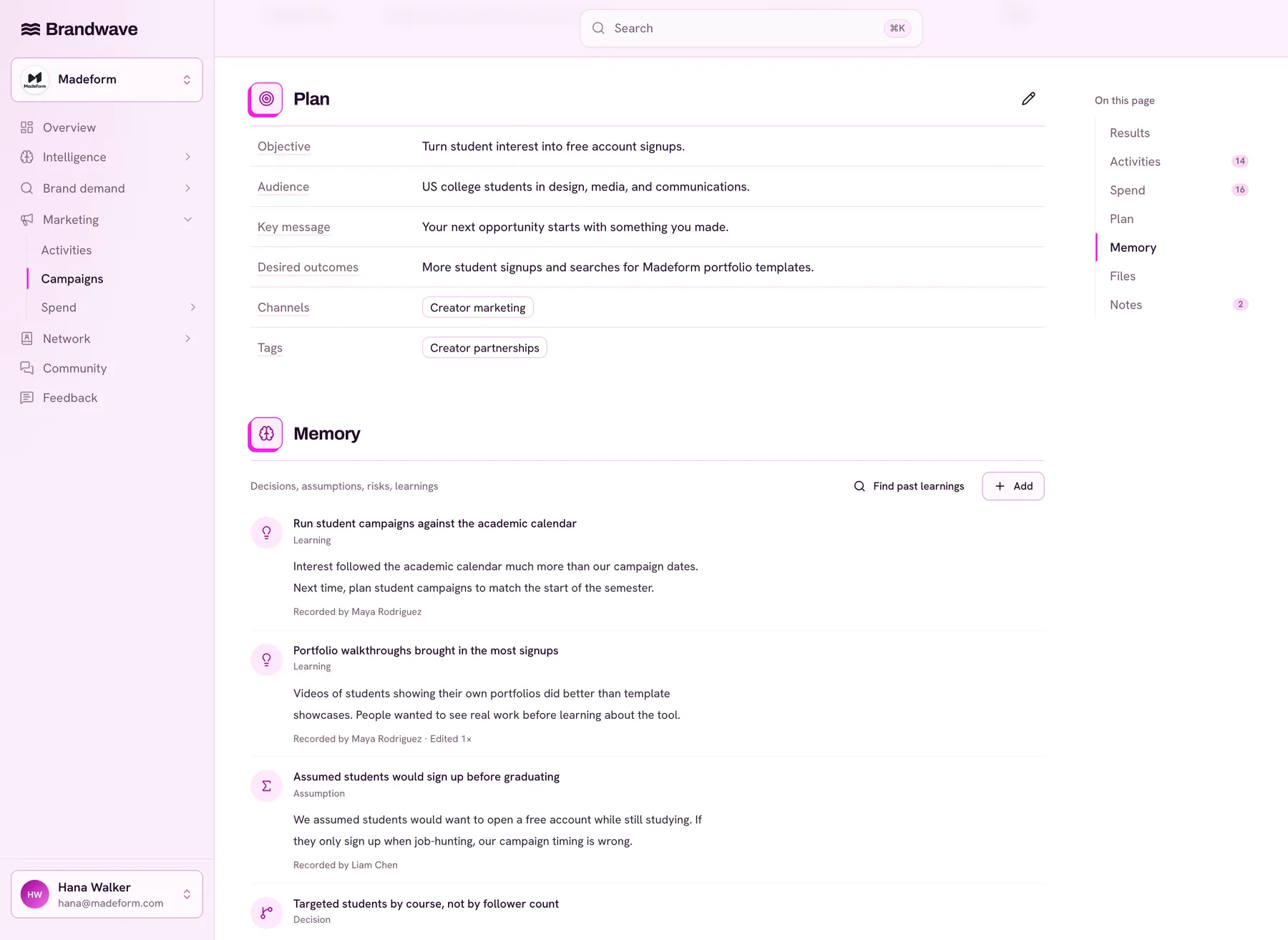
Use checkpoints to decide what to change
For a 12-week quarterly plan, I like to do a full review around week six. Are we making progress? Are we likely to reach our goal? What needs to change?
That doesn’t mean you should wait six weeks to spot broken tracking or an offer that isn’t working. Check those things sooner. The midpoint review gives you a chance to rethink your approach while there’s still time to make changes. In our work to improve search rankings, we tracked our positions for selected keywords. When we weren’t moving, or were slipping, we got together to examine the activity. At times that meant moving away from producing content for the sake of volume and toward a smaller number of higher-quality pieces.
The lesson isn’t that every SEO campaign should improve rankings in six weeks. It’s that a checkpoint should ask if the work and early results still support the plan, using a timeframe that fits the channel.
Tracking is incomplete or reporting has stopped.
- Repair the measurement and qualify the affected results before making a performance judgment.
Interest is relevant, but people do not progress to the next step.
- Examine the offer, sales handoff and follow-up before simply buying more traffic.
The audience is wrong or a critical assumption has failed.
- Change the targeting or approach, or stop if there is no credible fix within the budget.
Early signals fit the plan, but the normal sales cycle is not complete.
- Continue within the agreed limit and review commercial results at the planned date.
Results justify further investment.
- Consider a controlled increase, checking delivery capacity, lead quality and costs as spending grows.
| What you find | Decision to consider |
|---|---|
| Tracking is incomplete or reporting has stopped. | Repair the measurement and qualify the affected results before making a performance judgment. |
| Interest is relevant, but people do not progress to the next step. | Examine the offer, sales handoff and follow-up before simply buying more traffic. |
| The audience is wrong or a critical assumption has failed. | Change the targeting or approach, or stop if there is no credible fix within the budget. |
| Early signals fit the plan, but the normal sales cycle is not complete. | Continue within the agreed limit and review commercial results at the planned date. |
| Results justify further investment. | Consider a controlled increase, checking delivery capacity, lead quality and costs as spending grows. |
Cut repeated context, not the information needed to decide
Adjust the brief for the people who will use it. An internal team that knows the product may not need much company background. A new agency will probably need more context about the audience, offer, and past work.
Link to existing materials instead of repeating them. Make sure the objective, desired response, constraints, measures, and ownership are easy to find.
A vague audience description or a list of unused metrics isn’t helpful just because it’s in a template. Make each section specific enough to guide the work. For example, “small businesses” might not help with creative decisions, but a clear customer problem and buying situation will.
The real test is whether someone can explain what they need to deliver and how you’ll judge it. If removing a paragraph makes that harder, it probably should stay in the brief.
Turn the post-campaign review into the next brief
In retrospectives I’ve led, the rule is not to blame anyone. You still look closely at decisions. The goal is to understand what happened and improve the next campaign, not to make someone feel defensive. If only success is allowed, people will find a way to tell that story, and the business will keep making the same mistakes.
Review the campaign against the original brief, then write the practical consequence of each useful lesson.
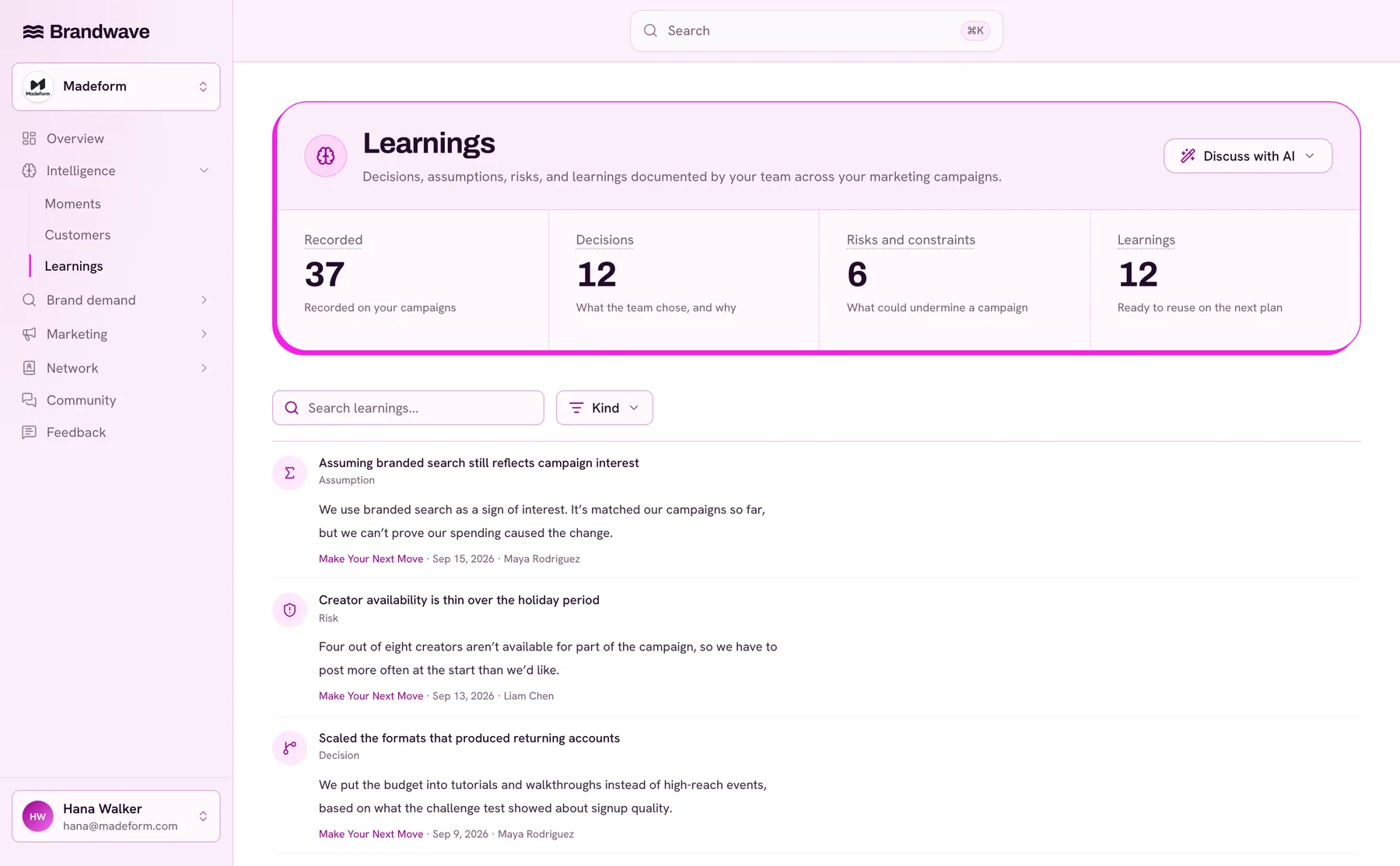
- Original expectation: What did we agree would happen, and by when?
- Actual result: What happened, what did it cost, and where is the proof?
- Changes: What did we change during the project, when did we make those changes, and why?
- Explanation: What do the numbers and customer feedback show, and what questions remain?
- Next brief: What should we keep, change, or try next, and who will handle it?
- Follow-up: Which results are still in progress, and who will check them and when?
Here’s a simple example of turning a lesson into an instruction. If animated ads performed worse than ads with people, the next brief might ask for photos or videos featuring people. That changes the creative approach, the budget, and who you need to involve.
Keep the comparison behind your recommendation. Animation isn’t a universal no-go. Instead, it’s a reason to try the next similar campaign differently or explain why a new test is worth doing.
Assign someone to carry the recommendations into the next brief. Keep the review with the original plan and supporting reports, not in a presentation that no one opens again. Our guide to marketing planning software explains how to organize your shared campaign history.
Software can help you store documents, and an AI assistant can help summarize them. Have the campaign owner check the summary, keep the source links, and make sure a target is not mistaken for an actual result. The tool should not rewrite the objective or make up missing explanations.
This is one reason I’m building Brandwave: to keep campaign activity, spending, notes, and supporting files in one place. The real value of a campaign is more than just the result. It’s a better starting point for your next decision.
FAQ
Sources
- Google Analytics: Collect campaign data with custom URLs (support.google.com)
- Google Analytics: About traffic-source dimensions (support.google.com)

Get the next article by email
Drop us your email and we'll let you know when we publish a new article.
By continuing you'll get an email for each new article and occasional product news from Brandwave. Unsubscribe any time. Privacy