On this page
- What to check before trusting an attribution report
- A traffic spike that turned out to be a bot attack
- Know what kind of evidence you’re looking at
- What if only 40 of 100 customers have a known source?
- Keep the cost visible even when attribution is incomplete
- When limited evidence is enough to try a channel
- Explain uncertainty to finance with a recommendation
- Marketing attribution software buyer checklist
- Run a marketing evidence-quality audit
- FAQ
What to check before trusting an attribution report
If a report recommends spending more on a channel, you should be able to explain why without depending on a vague score. What really happened? How much of the customer journey was tracked? What rules connected the result to that channel?
These questions matter whether you are choosing new attribution software or reviewing a report you already have. Check these basics before comparing first-click, last-click, or data-driven models.
- Source: Where is this number from? Can you check the original record?
- Definition: When we say conversion, do we mean a form submission, a qualified lead, a paid order, or something else?
- Coverage: For how many relevant customers or outcomes do we have usable source information?
- Timing: What time period does the data cover? When was it last updated? How much time did customers have to convert?
- Credit rules: Which interactions are counted? Over what time frame? Can more than one platform claim the same outcome?
- Context: Did anything else change in the campaign, product, sales process, or market?
The model you choose still matters. For example, last-click reporting answers a different question than a model that shares credit across several interactions. But it's important to check the quality of the information first, before picking a model.
A traffic spike that turned out to be a bot attack
At a company I worked with, the numbers looked good at first. Website traffic was up, and so was the conversion metric we tracked. At first glance, everything seemed to be going well.
But when I looked closer, something was wrong. The site was actually under a bot attack. What seemed like an improvement wasn’t real customer activity after all.
We didn’t make a big investment because of that spike, but it was a good reminder of how easy it is to see a chart, assume things are working, and move forward without looking deeper.
No change of attribution model would have solved that problem. The underlying evidence was wrong for the question we were asking.
If you see an unexpected jump in results, check what caused it before celebrating or spending more. Depending on the metric, this could mean reviewing real customer records, completed orders, lead quality, or unusual traffic patterns. A tracked event only matters if it shows the behavior you wanted to measure.
Know what kind of evidence you’re looking at
A paid order, a platform’s conversion claim, and a marketer’s explanation are all useful, but they mean different things. These five labels help you see the difference between what was recorded and how it was interpreted. One record can have more than one label because they cover different parts of the evidence.
Observed
- What it means
- A recorded action or result, such as a completed order or a submitted form.
- What to watch for
- Check that the record is genuine and the event definition matches the business outcome. A form submission is not a sale.
Reported
- What it means
- A figure supplied by an ad platform, agency, partner or customer.
- What to watch for
- Keep the source and its definition. Platform credit and a customer’s recollection answer different questions.
Mapped
- What it means
- Evidence connected to a campaign, channel or activity using an explicit rule or association.
- What to watch for
- Record the matching rule. Linking a tagged URL to a campaign does not establish that the campaign caused the purchase.
Estimated
- What it means
- A value calculated from a model and its assumptions rather than directly counted.
- What to watch for
- Ask which inputs, assumptions and uncertainty affect the estimate. Keep it distinguishable from observed results.
Inferred
- What it means
- An explanation drawn from the available numbers and context.
- What to watch for
- State the reasoning and what would change your mind. A plausible explanation is not a confirmed cause.
| Evidence | What it means | What to watch for |
|---|---|---|
| Observed | A recorded action or result, such as a completed order or a submitted form. | Check that the record is genuine and the event definition matches the business outcome. A form submission is not a sale. |
| Reported | A figure supplied by an ad platform, agency, partner or customer. | Keep the source and its definition. Platform credit and a customer’s recollection answer different questions. |
| Mapped | Evidence connected to a campaign, channel or activity using an explicit rule or association. | Record the matching rule. Linking a tagged URL to a campaign does not establish that the campaign caused the purchase. |
| Estimated | A value calculated from a model and its assumptions rather than directly counted. | Ask which inputs, assumptions and uncertainty affect the estimate. Keep it distinguishable from observed results. |
| Inferred | An explanation drawn from the available numbers and context. | State the reasoning and what would change your mind. A plausible explanation is not a confirmed cause. |
For example, your order system might confirm a sale, an ad platform might claim credit for it, and a customer might say they first heard about you at an event. You don’t have to ignore any of these, but counting them all as separate sales would be wrong.
Google’s attribution settings documentation shows how the reporting model and lookback window affect how credit is given. These settings shape what a report means, so they are not just technical details for the person who set up the tool.
What if only 40 of 100 customers have a known source?
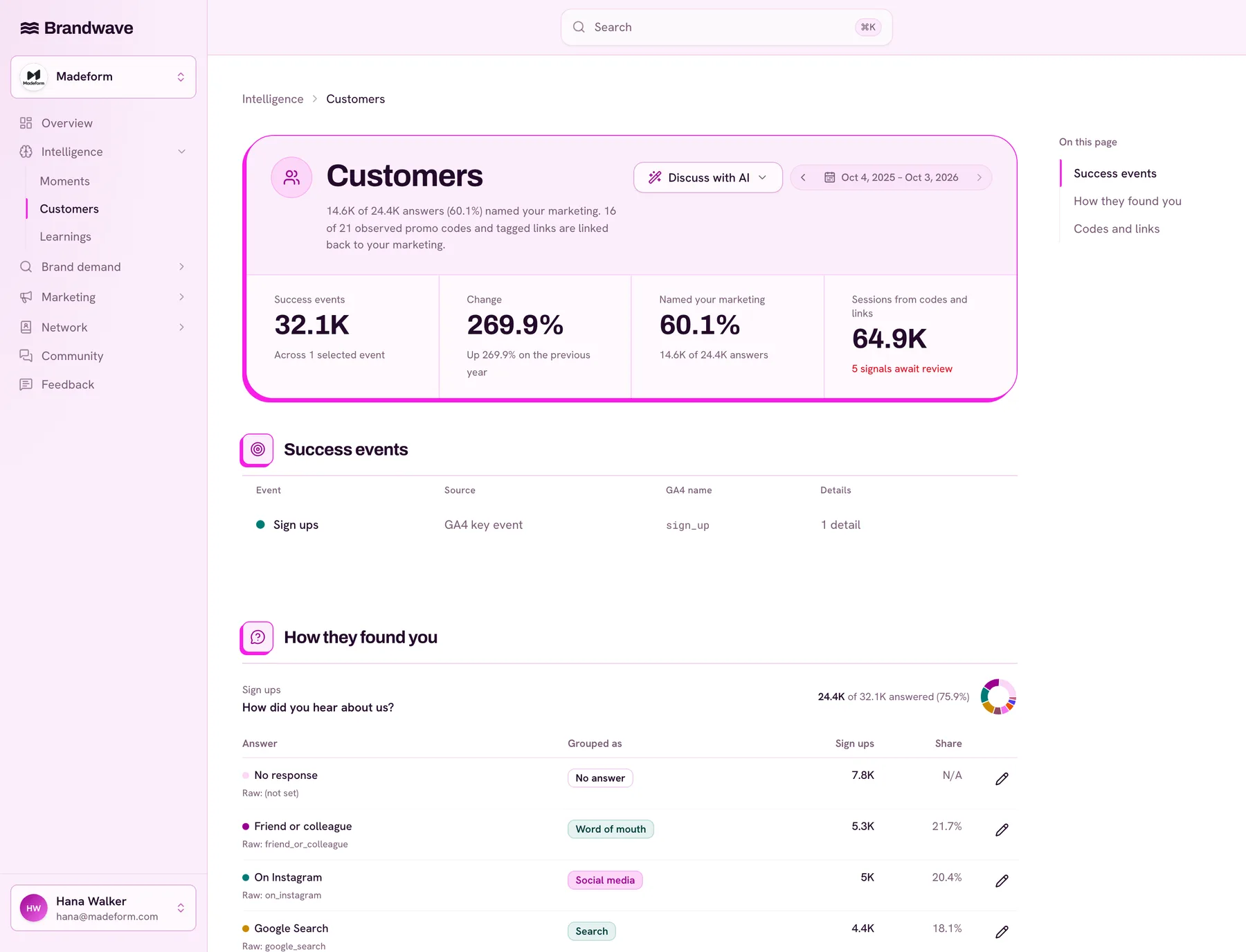
Here’s a hypothetical example: 100 new customers sign up, but only 40 have an identifiable marketing source. Your source coverage is 40%. The other 60 are still customers; their source is unknown.
If 20 of the identified customers came from paid search, that is half of the group with known sources. It does not mean paid search brought in half of all 100 customers. The unknown group might have taken different paths. Events, recommendations, and press coverage often leave less clear data than tagged ads.
You can use the 40 known customers to learn about the journeys you have tracked. Before using their proportions to set your whole budget, check if tracking changes by channel, device, consent, or sales process. Instead of guessing, show the unknown group in your report.
I have seen a similar issue with direct and organic traffic. You can see people arriving, but you do not always know what made them visit or search. Was it press coverage, an event, or something else they saw?
Check what marketing was happening at the time and see if customer feedback supports a connection. If you see an increase after an event, treat it as something to investigate, not as proof of how many customers came from that event. Asking customers how they heard about you adds helpful context to your analytics.
Keep the cost visible even when attribution is incomplete
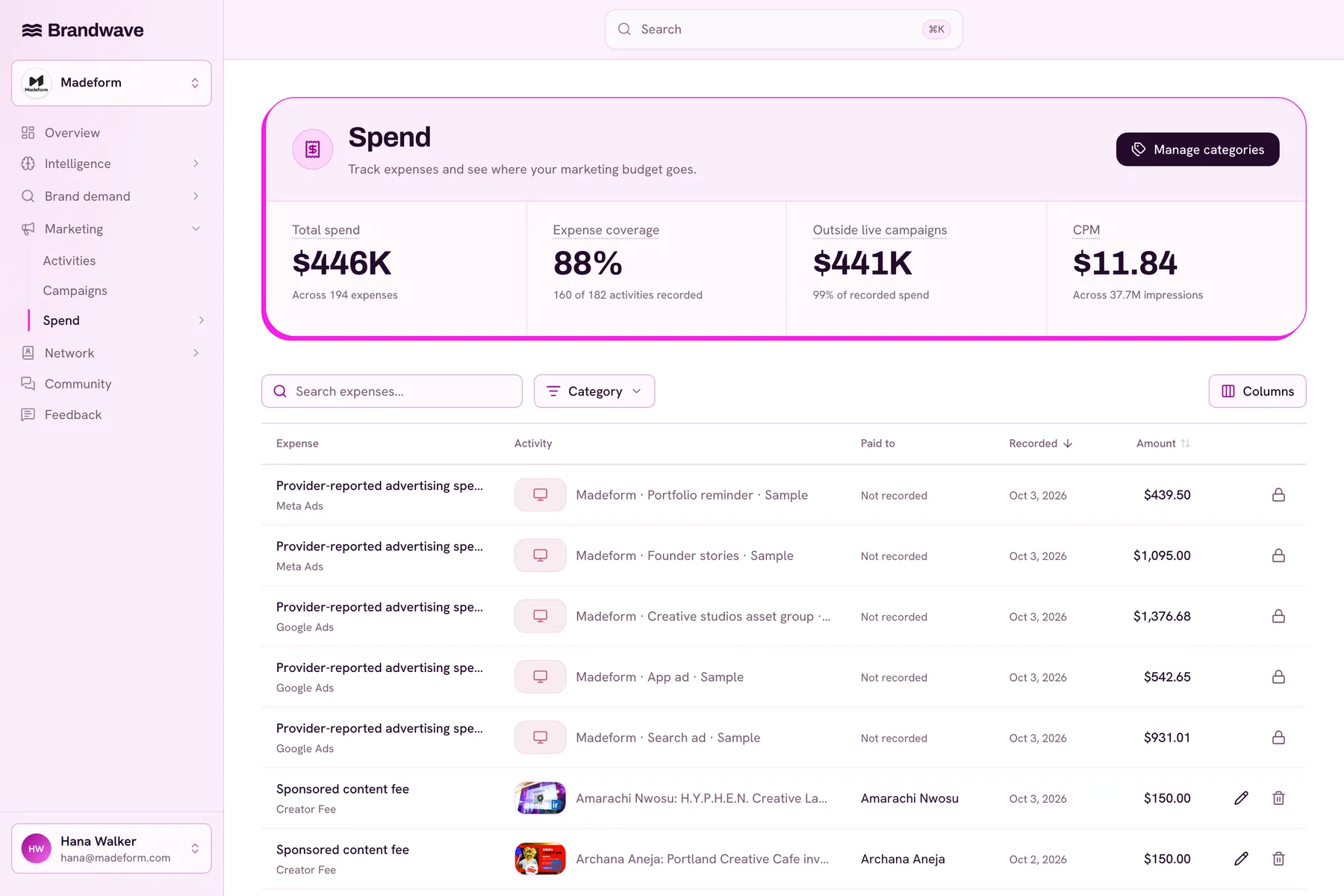
In previous work, I’ve allocated an estimate of staff capacity to activity that was difficult to trace directly to customers. That might mean accounting for the equivalent cost of a full-time employee working across that area.
This approach gave us a rough idea of the investment, instead of acting like the activity cost nothing just because there was no clear campaign invoice. The timing was not exact either, since work done in one month could lead to results later.
That is cost allocation, not conversion attribution. It helps answer what you’re investing, but it doesn’t tell you which share of the unknown customers came from that work.
Be transparent on both sides. Record your staff-cost estimate and explain how you calculated it. Show commercial results and supporting signals separately. Do not split up an assumed share of customers into the cost and call it a measured channel acquisition cost.
This distinction is also important when working out marketing ROI. Just knowing what you spent and seeing sales in the same period does not prove those sales were caused by your marketing.
When limited evidence is enough to try a channel
Talking to customers helped me decide to invest in events. Customers often mentioned events when explaining how they found us. There was not a lot of feedback, but it was consistent enough to make events worth testing.
We signed up for an event overseas. Our goal was to make a profit, not just get exposure. We saw the event as a success, which was encouraging since we didn’t know what to expect.
Talking to customers gave us a reason to invest, but it did not guarantee what the return would be or that every future event would succeed.
I use the same thinking for other channel decisions. Sometimes, evidence is enough to try a small test, but not enough for a large, ongoing investment. Make sure your commitment matches what you know.
Before testing a channel, set a spending limit, define the business result you want, and decide when you will review the outcome. If sales take time, choose which early signs matter and when you expect them to turn into real results.
If you have good conversations and a clear path to sales, it might make sense to keep going. But if you get irrelevant leads, high costs, or interest that never turns into sales, it is time to question the idea. A few positive comments are worth looking into, but they do not prove the channel works.
Explain uncertainty to finance with a recommendation
When talking to finance, do not just say “we do not know.” Explain what you do know, what is still unclear, and what you plan to do next. It is smart to test new channels before your current one stops working. A channel can get saturated or become less effective over time. If all your growth relies on one channel, you might end up scrambling for a replacement later.
Diversifying is a good reason to try new things, but it is not a reason to accept poor results forever. Show how your proposed investment fits into the bigger picture and what would justify giving it more budget.
Here’s an illustrative recommendation:
This gives finance a clear proposal to review: the evidence, what is still uncertain, the cost of learning more, and the next decision.
Marketing attribution software buyer checklist
When you compare marketing attribution tools, bring an actual report and ask the vendor to walk you through one conversion step by step. A nice-looking dashboard does not matter if you cannot see how the results were calculated.
- Can you trace a reported result back to its source and tell whether it was observed, estimated, or came from another platform?
- Is it clear how conversions are defined, which touchpoints are included, what attribution model is used, and what the lookback window is?
- Does the report show when source information is missing, or does it hide it somewhere else?
- Can you see when each source was last updated and which dates have all the data?
- How does the tool handle duplicate events and overlapping conversion claims from different platforms?
- Can you compare different reporting periods and still see any changes made to tracking or attribution settings?
- Can you keep customer feedback and campaign changes alongside the quantitative data?
- Can you export the underlying data and rules, or only a summary chart?
A platform’s conversion claim reflects its own rules for credit. Different platforms may each include the same customer. Ask how that overlap is handled before accepting a combined total.
Software can gather reports, match records based on set rules, and highlight gaps. But a budget recommendation still needs a person to review the campaign itself. Poor results might be due to the creative, audience, offer, timing, or sales process, not just a bad channel.
If a tool uses AI to explain performance, make sure its explanation links to real evidence and shows where it is making guesses. Do not let it quietly turn missing data into known facts or treat a simple link as proof of cause.
Run a marketing evidence-quality audit
Start with the next budget decision you need to make. Audit the evidence supporting that decision rather than trying to repair every report in the business at once.
For every key metric, note its source, definition, coverage, how current it is, credit rules, and any known limits. Assign each open issue to someone with a clear action. The goal is to decide if the evidence supports acting now, running a small test, or waiting until a big problem is fixed.
Marketing evidence-quality audit (CSV)
Import this checklist into Excel or Google Sheets. Record the evidence behind one budget decision, the gaps that matter and who will resolve them.
For your next campaign, decide what evidence you’ll need before you launch. The marketing campaign brief template links your goal, tracking plan, and review decisions.
I am building Brandwave because understanding the reasons behind marketing results is just as important as the numbers themselves. Keeping campaign activity, spending, notes, and supporting files in one place helps the team ask questions and learn.
The goal is not to find a model that makes every channel look certain. It is to understand the evidence well enough to make smart investment decisions.
FAQ
Sources
- Google Analytics: Select attribution settings (support.google.com)
- Google Analytics: Change the key event lookback window (support.google.com)
- Google Analytics: About traffic-source dimensions (support.google.com)

Get the next article by email
Drop us your email and we'll let you know when we publish a new article.
By continuing you'll get an email for each new article and occasional product news from Brandwave. Unsubscribe any time. Privacy