On this page
- The best fit by method and buyer job
- How this shortlist was selected
- Tracksuit: accessible always-on survey tracking
- Attest: custom tracking with wider consumer research.
- YouGov BrandIndex: frequent syndicated competitor benchmarks
- Kantar BrandDynamics: enterprise brand research and equity
- Brandwatch: social listening and consumer intelligence
- Google Ads Brand Lift: eligible campaign experiments
- Google Trends: free search-interest exploration
- Brandwave: the connected marketing and brand-demand record
- Build a starter stack or a mature stack.
- Use one source matrix for the evaluation.
- Make your decision in this order.
- FAQ
The best fit by method and buyer job
Run an accessible always-on brand tracker
- Best fit
- Tracksuit
- Method
- Continuous survey tracking with monthly rolling results
- Choose it over Brandwave when
- You need population-level awareness, consideration, preference, or associations from a managed survey panel
Build custom tracking and ad hoc consumer research
- Best fit
- Attest
- Method
- Quantitative and qualitative survey research
- Choose it over Brandwave when
- You need custom questionnaires, consumer recruitment, and a research manager
Benchmark brands frequently across many markets
- Best fit
- YouGov BrandIndex
- Method
- Daily syndicated survey tracking
- Choose it over Brandwave when
- You need daily survey benchmarks and broad market coverage
Use a broader enterprise brand-research suite
- Best fit
- Kantar BrandDynamics
- Method
- Brand tracking, equity, and forward-looking research
- Choose it over Brandwave when
- You need Kantar research methodology, benchmarking, and research services
Monitor online conversation and narrative
- Best fit
- Brandwatch Consumer Research
- Method
- Social listening and consumer intelligence
- Choose it over Brandwave when
- You need large-scale online-source coverage, query analysis, and historical conversation data
Estimate lift from an eligible Google campaign
- Best fit
- Google Ads Brand Lift
- Method
- Survey-based campaign experiment
- Choose it over Brandwave when
- You need a control comparison for Video or Demand Gen activity that meets platform eligibility
Explore relative search interest for free
- Best fit
- Google Trends
- Method
- Normalized search-interest index
- Choose it over Brandwave when
- You need a free exploratory signal and can manage term, market, and scaling limitations yourself
Connect brand demand to the work, evidence, and outcomes
- Best fit
- Brandwave
- Method
- Marketing intelligence and search-demand evidence
- Choose it over Brandwave when
- You need the decision record rather than a survey panel, listening firehose, or experiment platform
| Buyer job | Best fit | Method | Choose it over Brandwave when |
|---|---|---|---|
| Run an accessible always-on brand tracker | Tracksuit | Continuous survey tracking with monthly rolling results | You need population-level awareness, consideration, preference, or associations from a managed survey panel |
| Build custom tracking and ad hoc consumer research | Attest | Quantitative and qualitative survey research | You need custom questionnaires, consumer recruitment, and a research manager |
| Benchmark brands frequently across many markets | YouGov BrandIndex | Daily syndicated survey tracking | You need daily survey benchmarks and broad market coverage |
| Use a broader enterprise brand-research suite | Kantar BrandDynamics | Brand tracking, equity, and forward-looking research | You need Kantar research methodology, benchmarking, and research services |
| Monitor online conversation and narrative | Brandwatch Consumer Research | Social listening and consumer intelligence | You need large-scale online-source coverage, query analysis, and historical conversation data |
| Estimate lift from an eligible Google campaign | Google Ads Brand Lift | Survey-based campaign experiment | You need a control comparison for Video or Demand Gen activity that meets platform eligibility |
| Explore relative search interest for free | Google Trends | Normalized search-interest index | You need a free exploratory signal and can manage term, market, and scaling limitations yourself |
| Connect brand demand to the work, evidence, and outcomes | Brandwave | Marketing intelligence and search-demand evidence | You need the decision record rather than a survey panel, listening firehose, or experiment platform |
How this shortlist was selected
Brandwave made this comparison and is included in the list. We reviewed each vendor’s product and methodology pages as of August 31, 2026. We did not accept payments, use affiliate links, or rank products by feature count. We also did not list public prices, since most brand research tools use custom or sales-based pricing based on factors like markets, sample size, frequency, users, services, and study design.
This shortlist shows one good option for each buyer need, such as survey panels, brand-lift studies, social listening, search data, broader research suites, and marketing intelligence. There are other trustworthy vendors not listed here.
If you search for brand tracking tools on Google, you’ll find both brand monitoring and survey-based tracking mixed together. In this guide, we keep these methods separate so you don’t buy a mention monitoring tool when you want to measure brand awareness, or pick a survey tracker when you need to spot issues online.
Market and sample coverage
- Does it reach the buyer population and geography, and can you inspect sample, weighting, and exclusions?
Category and competitor definition
- Can you keep brands, search terms, topics, and category-entry points stable and auditable?
Cadence and lag
- Is the reliable reporting interval daily, monthly, rolling, quarterly, or per campaign?
Methodology and uncertainty
- Does the product disclose question design, normalization, panel quality, experiment eligibility, model assumptions, and limitations?
Historical baseline
- How much comparable history is available, and what creates a series break?
Export and access
- Can approved data move through spreadsheet export, API, warehouse, dashboard, or AI-assistant access?
Privacy and governance
- Who owns respondent, customer, campaign, and account data; what are the retention and permission controls?
Total cost
- Include markets, sample, questions, waves, seats, services, API, exports, implementation, and renewal terms, not only a headline price.
| Criterion | Question to verify |
|---|---|
| Market and sample coverage | Does it reach the buyer population and geography, and can you inspect sample, weighting, and exclusions? |
| Category and competitor definition | Can you keep brands, search terms, topics, and category-entry points stable and auditable? |
| Cadence and lag | Is the reliable reporting interval daily, monthly, rolling, quarterly, or per campaign? |
| Methodology and uncertainty | Does the product disclose question design, normalization, panel quality, experiment eligibility, model assumptions, and limitations? |
| Historical baseline | How much comparable history is available, and what creates a series break? |
| Export and access | Can approved data move through spreadsheet export, API, warehouse, dashboard, or AI-assistant access? |
| Privacy and governance | Who owns respondent, customer, campaign, and account data; what are the retention and permission controls? |
| Total cost | Include markets, sample, questions, waves, seats, services, API, exports, implementation, and renewal terms, not only a headline price. |
Tracksuit: accessible always-on survey tracking
Tracksuit is a great choice if your team wants ongoing brand-health surveys without having to set up a research program from the ground up. According to their current guidelines, surveys run all the time, results are updated monthly, and brand and category metrics use a three-month rolling average. Tracksuit also explains how they manage their survey panels and clean the data.
This setup is good for tracking awareness, consideration, preference, usage, and associations over time. The rolling average helps you avoid reacting to small weekly changes, but you should also know how long it takes for real changes to appear in the data.
Pick Tracksuit instead of Brandwave if you mainly need survey-based brand health data from a panel of respondents. Brandwave can link this evidence to activities, costs, demand, and outcomes, but it does not run surveys or recruit participants. Ask Tracksuit for a detailed quote that covers markets, categories, competitors, sample size, metrics, services, exports, and contract terms.
Attest: custom tracking with wider consumer research.
Attest is a good choice if you need brand tracking with custom questions, deeper insights, and one-off consumer research all in one place. Their current brand-tracker page mentions custom trackers, AI-powered analysis, and a dedicated research manager. They also say you can reach over 150 million consumers in 59 markets.
Choose Attest instead of Brandwave if you need to do primary consumer research, like recruiting audiences, designing questionnaires, running surveys, and getting expert analysis. Brandwave does not offer these services or provide a respondent panel.
When you evaluate, ask which markets and audiences you can reach, how incidence rates affect your options, how sampling and weighting are handled, what stays the same between survey waves, and what deliverables or raw data exports are included in the quote.
YouGov BrandIndex: frequent syndicated competitor benchmarks
YouGov BrandIndex is a strong option if you want frequent, syndicated brand and competitor benchmarks in many markets. According to YouGov, BrandIndex uses thousands of consumer interviews to track brands daily in 56 markets and compares brands within their sectors.
A syndicated tracker can save setup time and provide competitor context, which is helpful for large brands already being measured. However, if you’re in a niche B2B or small market, the available audience, questions, brands, and categories might not fit your needs.
Pick YouGov BrandIndex instead of Brandwave if you need daily survey data on awareness, impressions, quality, value, consideration, reputation, or similar brand health measures. Brandwave does not track these survey metrics. Ask YouGov if your brand, competitors, target audience, market, history, API or export needs, and service model are included.
Kantar BrandDynamics: enterprise brand research and equity
Kantar BrandDynamics is the enterprise research suite option here. Kantar says it offers real-time brand and competitor tracking in Kantar Marketplace, with an interactive dashboard, automated scorecards, brand equity metrics, and forward-looking insights.
Choose Kantar instead of Brandwave if you need Kantar’s survey methods, brand equity frameworks, research services, benchmarks, or access to their wider Marketplace studies. This is best for teams that want a research partner, not just a software tool.
When buying, focus on defining your needs. Confirm the markets, population, sample size and weighting, categories and competitors, questionnaire, historical baseline, reporting frequency, forecasting method, service level, exports, user access, and total contract cost.
Google Ads Brand Lift: eligible campaign experiments
Google Ads Brand Lift is the campaign experiment tool on this list. Google says it’s a free tool for eligible Video and Demand Gen campaigns that measures things like ad recall, brand awareness, association, and consideration. It does this by comparing survey responses from people who saw the ads and those who didn’t.
Choose Google Brand Lift instead of Brandwave if you want to know whether a specific Google campaign caused a change in a brand metric for your target group. Brandwave is not an experiment platform, but it can keep records of the campaign, spend, outcome, and evidence after the study.
Check if your account and campaign are eligible, what the minimum spend is, study timing, question and response requirements, statistical power, baseline response, how exposed and control groups are defined, and whether the platform’s audience matches the group you want to reach.
Google Trends: free search-interest exploration
Google Trends is a free tool to explore search interest by term, topic, time, and location. Google says Trends samples and normalizes search data by time and place, then scales the results. It does not show raw search volume.
Choose Google Trends instead of Brandwave if you want a quick, free way to explore search interest and can handle term ambiguity, category filters, geography, scaling, and manual competitor comparisons. It’s useful for forming ideas, but not for showing exact demand numbers.
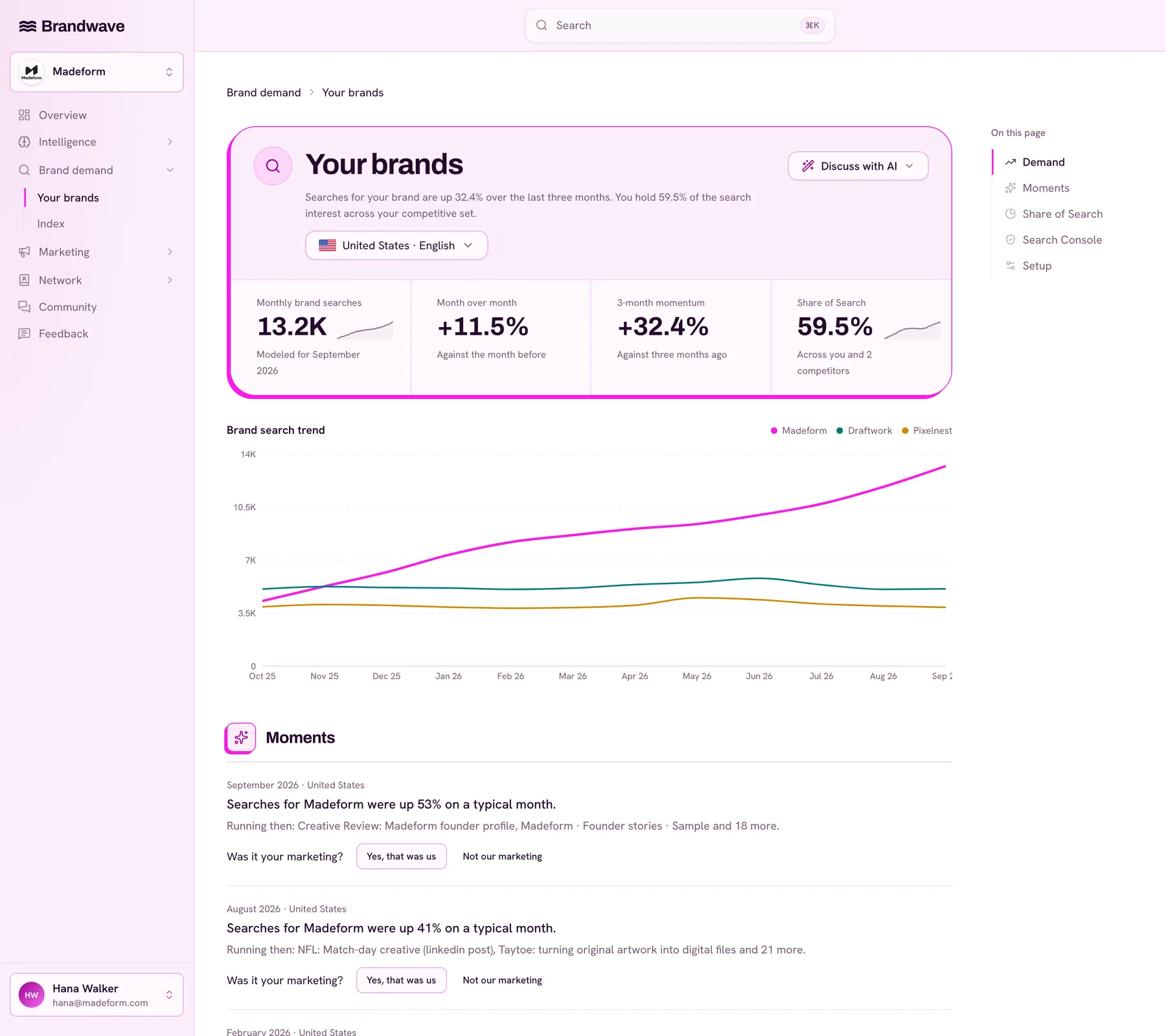
Choose Brandwave if you need 12 full months of estimated branded search demand and competitor Share of Search for a specific market. It also lets you keep first-party Search Console data separate from estimates and connects search evidence to your campaign, cost, customer, and outcome history.
Brandwave: the connected marketing and brand-demand record
Brandwave is a good choice if you want to see all your work, spending, evidence, demand, and outcomes in one place, instead of just collecting another isolated metric. It does more than just Share of Search software.
Brandwave gives you 12 months of estimated branded search demand and competitor Share of Search for your chosen market. Your team can connect Google Search Console and review first-party data separately from estimates. Brandwave also records campaigns, activities, creators, costs, outcomes, and metrics; tracks campaign health and comparisons; prepares marketing briefs for stakeholders; and offers evidence-based recommendations.
GA4 success metrics in Brandwave can come from key events, regular events, or Google Tag Manager tags, and you can backfill historical data and use custom dimensions. HDYHAU reporting includes raw responses, reusable normalization and category mappings, response coverage, creator relevance, data quality flags, and a daily evidence timeline. Direct-signal workflows track promo-code and tagged-link evidence, explicit mappings, and let you ignore or restore data as needed. These workflows do not automatically assign conversions or claim causation.
For creator programs, Brandwave tracks activity and performance on Instagram, YouTube, TikTok, X, LinkedIn, and Reddit, along with costs and outcomes. You can access the marketing record through the web app, public HTTP API, or MCP server for AI assistants.
Choose a specialist tool instead of Brandwave if you need a survey panel, help with questionnaires and sample management, web-wide social listening, brand-lift experiments, marketing-mix modeling, or causal attribution. Pick Brandwave if you want to connect those specialist results to your actual marketing work and future investment decisions.
Build a starter stack or a mature stack.
No-cost baseline
- Components
- Google Trends, Search Console, GA4 success event, HDYHAU field, source matrix
- Good fit
- Early team validating the questions
- Main trade-off
- Manual history, definitions, cleaning, and review
SMB operating stack
- Components
- Quarterly survey or Tracksuit, Brandwave, GA4, Search Console, monthly decision review
- Good fit
- Team connecting perception, demand, activity, and outcomes
- Main trade-off
- Requires disciplined ownership and a stable survey scope
Campaign-learning stack
- Components
- Survey tracker, Google Brand Lift for eligible campaigns, Brandwave decision record
- Good fit
- Team testing selected media while tracking wider demand
- Main trade-off
- Experiment evidence covers only eligible campaigns and populations
Mature insights stack
- Components
- YouGov or Kantar, Brandwatch, experiment and modeling partners, warehouse or BI, Brandwave
- Good fit
- Multi-market team with research and analytics specialists
- Main trade-off
- High cost and governance burden; overlapping tools must have explicit owners
| Stack | Components | Good fit | Main trade-off |
|---|---|---|---|
| No-cost baseline | Google Trends, Search Console, GA4 success event, HDYHAU field, source matrix | Early team validating the questions | Manual history, definitions, cleaning, and review |
| SMB operating stack | Quarterly survey or Tracksuit, Brandwave, GA4, Search Console, monthly decision review | Team connecting perception, demand, activity, and outcomes | Requires disciplined ownership and a stable survey scope |
| Campaign-learning stack | Survey tracker, Google Brand Lift for eligible campaigns, Brandwave decision record | Team testing selected media while tracking wider demand | Experiment evidence covers only eligible campaigns and populations |
| Mature insights stack | YouGov or Kantar, Brandwatch, experiment and modeling partners, warehouse or BI, Brandwave | Multi-market team with research and analytics specialists | High cost and governance burden; overlapping tools must have explicit owners |
Start with one decision and only add a specialist tool if its method will actually change your choice. A more advanced stack isn’t always better. It only makes sense if your organization has the markets, budget, volume, expertise, and governance to use it well.
Use one source matrix for the evaluation.
Don’t compare tools using a generic feature grid. Instead, give every vendor the same business question, market, category, competitor definition, baseline, observation window, cadence, owner, confounders, confidence requirement, and supported decision.
The workbook below goes with the brand measurement method guide. It has example signal rows, editable fields, readiness formulas, method boundaries, and a monthly decision review.
Brand measurement source matrix
Define what the buyer needs and compare different methods honestly, without pretending they give the same kind of evidence. The workbook includes source readiness and monthly review formulas.
Make your decision in this order.
- Write down your decision and specify the population, market, or campaign it applies to.
- Pick your method: stated perception, online conversation, search behavior, experimental lift, customer evidence, business outcomes, or a connected record.
- Set the minimum sample, source, history, cadence, and export requirements.
- Ask every shortlisted vendor to expose methodology, uncertainty, series breaks, and implementation work.
- Run one proof period using your real competitors, terms, questions, campaign, or data.
- Evaluate the decision produced, not only the dashboard shown.
- Record why the winner fits and which blind spots still require another method.
Start with the measurement method.
Define what awareness, salience, consideration, preference, demand, and outcomes require before buying software.
Go deeper on the search-demand method.
Learn how to calculate Share of Search, choose terms and competitors, compare data sources, and recognize weak evidence.
FAQ
Sources
- Tracksuit: How frequently does Tracksuit survey? (help.gotracksuit.com)
- Tracksuit: How does Tracksuit clean the data? (help.gotracksuit.com)
- Tracksuit: Why use a three-month rolling average? (help.gotracksuit.com)
- Attest: Brand tracking (askattest.com)
- YouGov: BrandIndex (yougov.com)
- Kantar Marketplace: Brand tracking (kantar.com)
- Brandwatch: Consumer Research (brandwatch.com)
- Google Ads Help: About Brand Lift (support.google.com)
- Google Trends: FAQ about Google Trends data (support.google.com)
- Pew Research Center: Writing survey questions (pewresearch.org)
- Brandwave: HTTP API reference (gobrandwave.com)
Get the next article by email
Drop us your email and we'll let you know when we publish a new article.
By continuing you'll get an email for each new article and occasional product news from Brandwave. Unsubscribe any time. Privacy