On this page
What happened
On 19 June 2026, the YouTube channel Kino House Investigates posted a video about NZ Muscle. The video accused the company of relabelling third-party protein as its own, selling short-dated or expired stock without telling customers, making misleading claims about product origins and protein content, and packing products poorly. By late August, the video had more than 350,000 views.
On 22 June, NZ Muscle admitted that some No Brand Isolate and No Brand Whey Plus products had been "inappropriately relabelled." The company took these products off the shelves and admitted there were issues with packing and labelling, but denied the other accusations. The next day, founder Dion Roosenbrand told Stuff he had "lost sight of some of the values" the business was built on, and said his family had received threats since the video came out.
Within a few days, two government agencies started looking into the company. New Zealand Food Safety said it was investigating possible breaches of the Food Act. On 26 June, it recalled batches of NZ Muscle Creatine and No Brand Creatine that might contain milk not listed on the label. The Commerce Commission began a preliminary review of 41 public complaints, and on 24 August, it launched a full investigation under the Fair Trading Act.
In July, Dave Letele took over as chief executive from Roosenbrand, but on 20 July, he announced he was stepping down. As of October, neither investigation had shared any results.
What the Brand Demand Index recorded
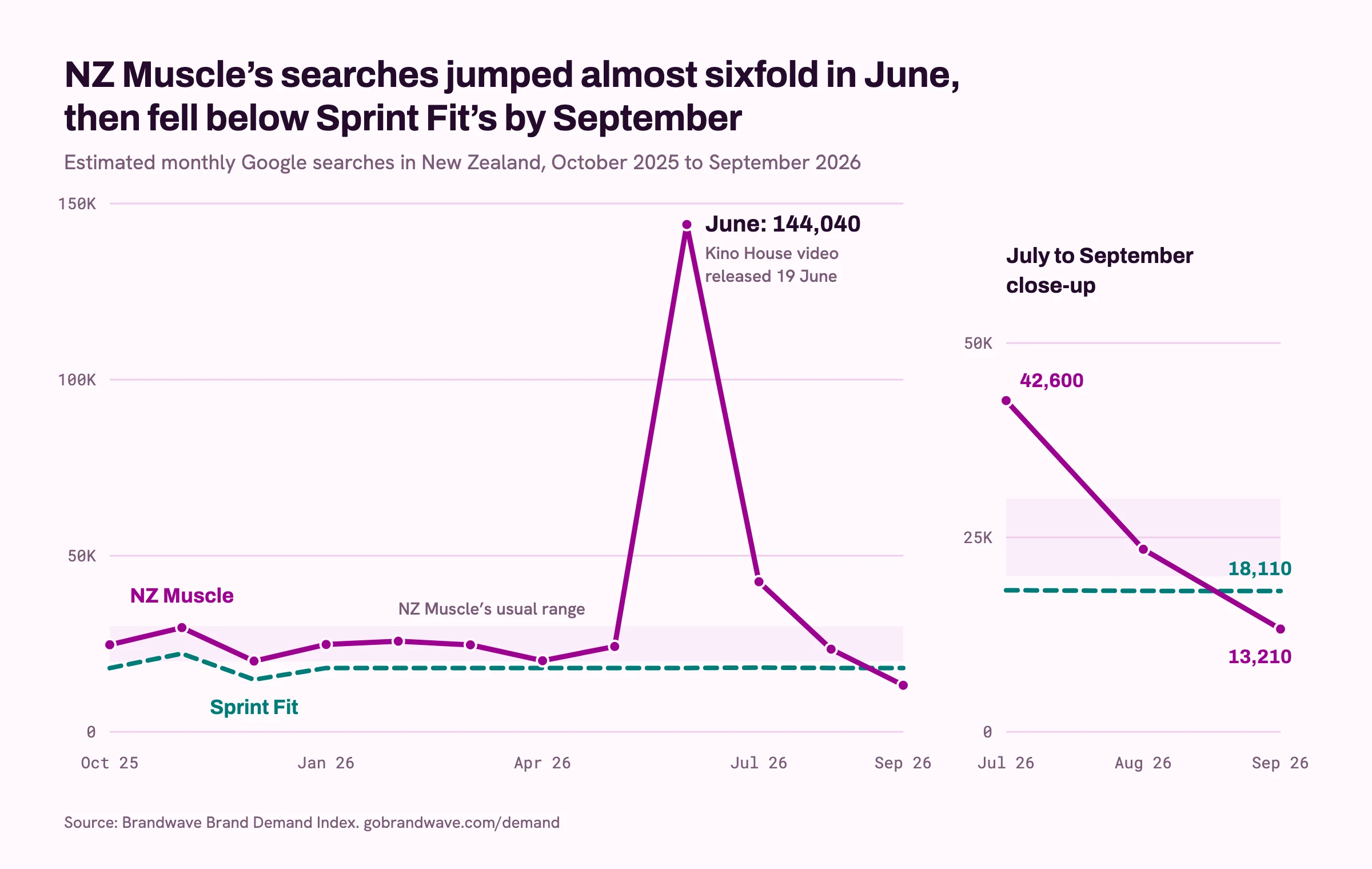
Oct 2025 to May 2026
- NZ Muscle searches
- 20,080 to 29,580
- Sprint Fit searches
- 14,810 to 22,210
- NZ Muscle Share of Search
- 39% to 45%
June 2026
- NZ Muscle searches
- 144,040
- Sprint Fit searches
- 18,110
- NZ Muscle Share of Search
- 81%
July 2026
- NZ Muscle searches
- 42,600
- Sprint Fit searches
- 18,210
- NZ Muscle Share of Search
- 56%
August 2026
- NZ Muscle searches
- 23,470
- Sprint Fit searches
- 18,120
- NZ Muscle Share of Search
- 41%
September 2026
- NZ Muscle searches
- 13,210
- Sprint Fit searches
- 18,110
- NZ Muscle Share of Search
- 29%
| Month | NZ Muscle searches | Sprint Fit searches | NZ Muscle Share of Search |
|---|---|---|---|
| Oct 2025 to May 2026 | 20,080 to 29,580 | 14,810 to 22,210 | 39% to 45% |
| June 2026 | 144,040 | 18,110 | 81% |
| July 2026 | 42,600 | 18,210 | 56% |
| August 2026 | 23,470 | 18,120 | 41% |
| September 2026 | 13,210 | 18,110 | 29% |
You can find the full chart and monthly table in the NZ Muscle and Sprint Fit comparison.
Both positive and negative attention can cause search spikes
Branded search counts everyone who typed the company’s name. In June, this included people checking if their product was affected, people following the news, and those who had just heard about NZ Muscle from the video. The search terms reveal what people wanted to know: "nz muscle reviews" went from about 10 a month to 2,900, and "nz muscle supplements" rose from about 30 to 3,600.
Without that context, an 81% Share of Search could make it seem like the brand leads its category. The searches were real, but they weren't from a rush of customers looking to buy.
Sustained increase in search demand vs the spike
The months after a spike tell you more than the spike itself. NZ Muscle usually gets about 24,000 searches a month. July was still high at 42,600, but August went back to normal at 23,470. In September, searches dropped to 13,210, the lowest in the Index’s 13 months, mostly because searches for "nz muscle" fell from 22,200 to 12,100.
One month is not enough to call it a trend. September might just be a dip before NZ Muscle returns to normal, or it could be the start of a decline. The next few months will show what happens. Either way, the spike did not lead to lasting search demand. Whether "all publicity is good publicity" fits here depends on how NZ Muscle recovers after the controversy. Since we don't have public sales data, the next few months will be interesting to watch from a branded search perspective.
Reading a spike in your own branded search
- Before you report a spike, figure out what caused it. Check the news, your support inbox, and your "how did you hear about us?" responses.
- Compare your spike with your competitors. If their searches also went up at the same time, the cause was probably seasonal or affected the whole category.
- Look at the next two or three months and compare them to your usual numbers. A lasting change matters more than a single peak.
- Compare search spikes with your sales and sign-ups. Branded search is only one indicator and cannot show if the attention is good or bad.
Sources
- rova, NZ Muscle controversy: the allegations (rova.nz)
- rova, NZ Muscle apologises and admits to packing and labelling issues (rova.nz)
- Stuff, NZ Muscle boss says he lost sight of some of the values (stuff.co.nz)
- bitu, Food Safety investigating NZ Muscle (bitu.nz)
- MPI, creatine recalled due to undeclared dairy (mpi.govt.nz)
- NZ Herald, Commerce Commission launches formal probe into NZ Muscle (nzherald.co.nz)
- Newswire, Dave Letele becomes NZ Muscle chief executive (newswire.co.nz)
- 1News, Dave Letele announces he is leaving NZ Muscle (1news.co.nz)
- Brand Demand Index, NZ Muscle and Sprint Fit comparison (gobrandwave.com)

Get the next article by email
Drop us your email and we'll let you know when we publish a new article.
By continuing you'll get an email for each new article and occasional product news from Brandwave. Unsubscribe any time. Privacy