On this page
- What AI visibility measures
- AI visibility, GEO, AEO and SEO
- Why AI visibility matters now
- Mentioned, recommended and cited
- How to measure AI visibility
- What influences whether AI recommends you
- The limits of AI visibility data
- AI visibility tools and audits: what to look for
- How Brandwave tracks AI visibility
- FAQ
What AI visibility measures
Most definitions of AI visibility cover five things. The first is whether you’re mentioned at all. The second is your position, because being named first in a list of five is worth more than being named last. Then there are citations, the links an answer gives as its sources. Accuracy is whether the AI gets your prices, products and company right. Consistency is whether you keep showing up when the question is reworded or asked again.
Most tools turn these into a percentage: out of all the answers to a set of questions, how many mention your brand. This works like share of voice and is most useful when you compare your figure with your competitors’.
AI visibility, GEO, AEO and SEO
SEO is about ranking in regular search results. GEO (generative engine optimization) and AEO (answer engine optimization) both mean getting your brand into AI answers, and people often use the two terms for the same thing. AI visibility shows whether that work is paying off.
SEO still matters. Google says a page needs to be indexed and able to show a snippet before AI Overviews or AI Mode can link to it. Pages that rank well are cited more often, but even a top ranking doesn’t guarantee your brand will show up in the AI answer.
Why AI visibility matters now
A search results page usually gives people ten links so they can compare options themselves. An AI answer does the comparing for them and gives just a few names. Microsoft Advertising’s guide to GEO puts it well: “SEO is how you won in search. GEO is how you win the recommendation.”
Many people now use AI assistants to get answers. ChatGPT has over a billion weekly users, and Google’s AI Mode and Gemini app each have more than a billion monthly users. Pew Research found that people clicked on search results about half as often when an AI summary was shown. If an AI answer mentions your brand, buyers might remember you even if they never visit your site. If your brand is left out, your analytics won’t show it.
For most websites, visits from AI assistants are still a small part of their traffic, but that share is growing quickly. For a few companies it’s already the biggest source of new customers. Tally, the form builder, says AI search is now its biggest acquisition channel.
Branded search doesn’t show this. As our guide to branded search explains, it only counts people who already search for your brand by name. It doesn’t show whether AI recommends you to people who don’t know you yet. A brand that AI often recommends can do well even with modest branded search numbers, while a well-known brand can sit low in AI answers without it showing up in search data.
The Brand Demand Index measures this gap every month. In September 2026, ChatGPT and Google AI Overviews named the most searched brand first in 34% of answers across 5,497 categories, and never named it first in 40% of categories. The AI search statistics provide the full figures by market and by how dominant the leading brand is.
Mentioned, recommended and cited
A mention means the answer includes your brand name. A recommendation means the AI suggests you as a good choice, often near the top of the list. A citation means the answer links to a page as a source. These three don’t always match up. An answer might cite your blog post but recommend a competitor, or recommend you but link to a review site.
Citations matter a lot in Google, where they are clickable links. Seer Interactive found that brands cited in Google’s AI Overviews got two to five times more clicks than brands that weren’t cited.
Accuracy is often overlooked. AI assistants might get your prices wrong or describe products you no longer offer, or refuse to answer questions about your brand. Read what they say about you as well as counting how often they mention you.
How to measure AI visibility
You can check your AI visibility yourself before paying for a tool.
Start by listing the questions your buyers ask, but leave out your brand name. Think about the tasks people need help with, like “best accounting software for a small café” or “QuickBooks vs FreshBooks for a sole trader.” Comparison and “best” questions are a good place to start, since Google shows an AI Overview for most of them. Ten to twenty questions is enough to begin.
Try asking more than one AI assistant. ChatGPT is still the biggest, but Gemini and Claude have grown quickly in the past year. Check ChatGPT, Google’s AI Overviews and AI Mode, and any assistant your customers mention. Use the actual apps people use, since answers from developer APIs can be different.
For each answer, note if your brand was mentioned, where it showed up, which competitors were listed, if your site was linked, and if the description was accurate.
Next, ask each question several times, and repeat the process next month. When SparkToro had volunteers run the same questions nearly 3,000 times, the chance of two answers giving the same list of brands was less than one in a hundred. One answer doesn’t tell you much. Tracking how often your brand is mentioned across many answers and over several months gives you a better idea.
Finally, ask new customers how they found you. Tally’s onboarding survey asks people which prompt they used if they found it through an AI assistant. This gives you real questions to track, and some evidence that AI answers bring in customers. Our guide to recording how customers heard about you shows one way to collect these answers.
What influences whether AI recommends you
No one outside the AI companies knows exactly how brands are chosen, and you can’t rank in ChatGPT the same way you do in Google. Still, the companies’ own advice and the larger studies point the same way.
Google says you don’t need special optimizations, AI text files, or extra markup to show up in AI Overviews or AI Mode. Its AI features run several related searches to build an answer, so a page that also covers common follow-up questions has more chances to be included. OpenAI says ChatGPT picks shopping results based on what the person asked for and any context they’ve given, looking at things like price, reviews and product details from merchants and third parties. The results aren’t ads, and OpenAI’s partnerships don’t influence them.
What others say about your brand seems to matter most. Ahrefs studied 75,000 brands and found that the number of times a brand was mentioned online matched its AI visibility more closely than backlinks or branded search volume. This is just a correlation, but it fits with the sites AI tools cite most: Reddit, LinkedIn, Wikipedia and YouTube. The Reddit and LinkedIn posts they cite are rarely viral. They’re usually straightforward, helpful answers to specific questions.
These sources can change too. ChatGPT’s citations of Reddit dropped sharply in August 2025 and again in August 2026. Teams that depended on one community saw their exposure drop almost overnight. It’s safer to be discussed in many different places.
One common tip doesn’t have evidence behind it. An llms.txt file is supposed to guide AI tools to your best content, but a study of about 300,000 sites found it made no noticeable difference in how often a site was cited.
In practice, make sure your pages clearly say what you sell, who it’s for, and what it costs, so AI can describe your brand accurately. Write honest comparison pages that answer buyers’ questions. Then, earn mentions in places your buyers already visit, like reviews, communities, industry press, and posts from people who use your product.
The limits of AI visibility data
AI answers change every time. The brands mentioned, their order, and the sites cited can all vary from one run to the next, so every tool is just sampling. Look at the numbers as a trend over many answers and months, and be careful about relying on just one month’s data.
No one knows exactly what people ask. AI companies don’t share the questions users type, so any score depends on which questions are chosen. Two tools using different questions will give the same brand different scores.
AI answers can also be manipulated. Thomas Germain, a BBC journalist, spent 20 minutes writing a fake article on his website ranking the best tech journalists at eating hot dogs, with himself at the top. Within a day, ChatGPT and Google’s AI were repeating it. If one blog post can have that effect, a sudden jump in visibility for you or a competitor may not last.
AI visibility tools and audits: what to look for
There are now many AI visibility tools, checkers, and audits out there. A free checker that asks just one question gives you a quick first look, but not much more. When comparing tools, think about these questions.
- Which assistants does it cover, and does it read the answers people see in the apps?
- Can you write your own questions?
- How often does it ask each question, and does it show how much the answers vary?
- Does it separate mentions, position, citations and accuracy, or blend them into one number?
- Can you compare yourself with the competitors you choose, on the same questions?
- Can you read the full answers behind each score?
How Brandwave tracks AI visibility
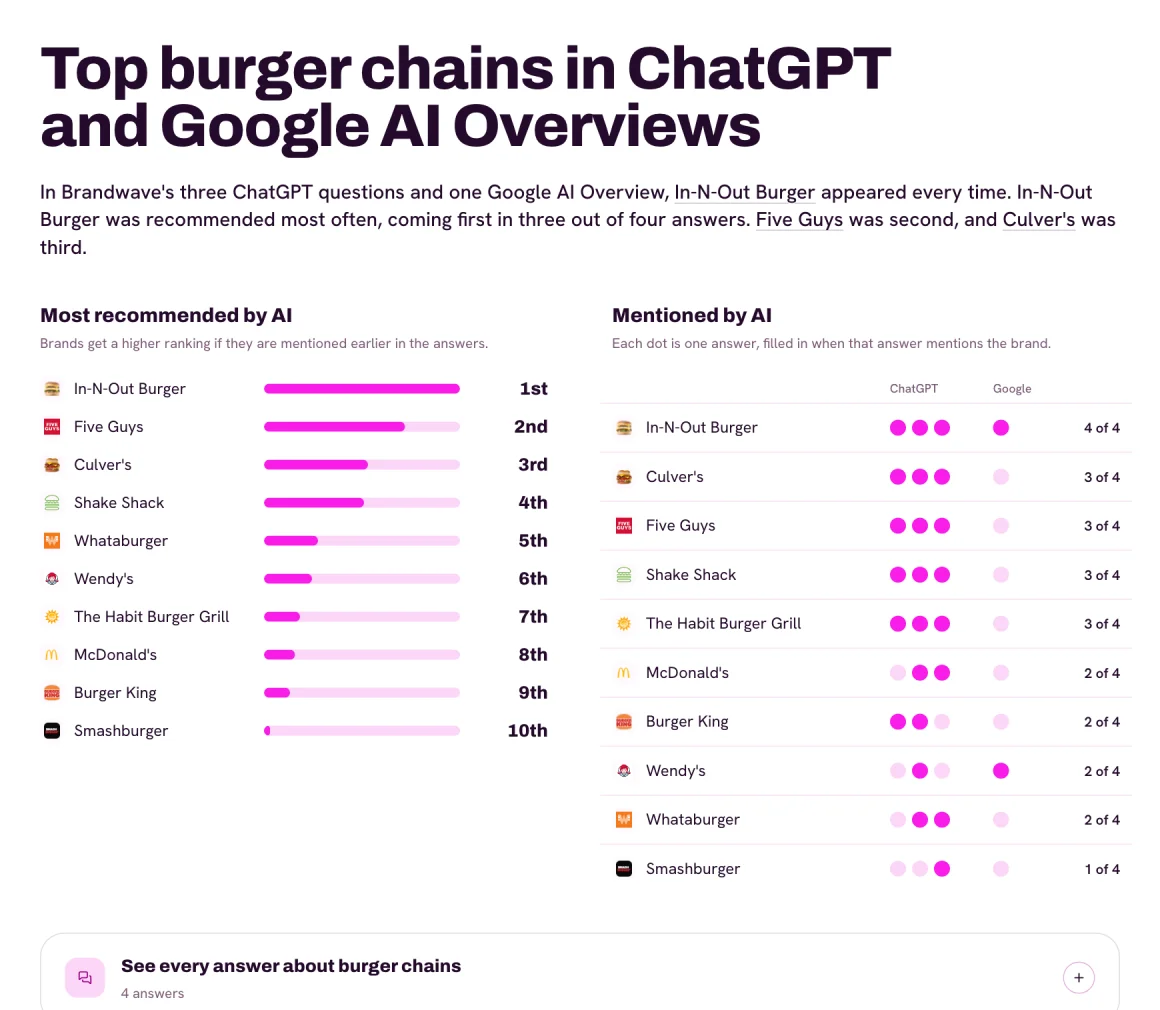
In a Brandwave workspace, the AI visibility page has two parts. The first compares your brand with the competitors you track, using the Brand Demand Index’s questions for your category. The Index asks ChatGPT and Google the same questions every month, and nobody can change them, so the comparison stays fair from one month to the next. It shows how many answers mention each brand and where each one comes in the recommendations.
The second part is your own questions. Brandwave asks each one once a month in ChatGPT and in Google search with its AI Overview, and shows you both answers so you can read what they say about you. Because a single answer can vary, look across all your questions over several months. The Free plan includes 5 AI questions a month for each brand, and paid plans include more.
The Index’s questions are the same for every brand in a category, which makes them a quick overview. Your own questions can match your buyers more closely. Create a free Brandwave account to add them.
FAQ
Sources
- Google Search Central: AI features and your website (developers.google.com)
- Microsoft Advertising: From discovery to influence, a guide to GEO (about.ads.microsoft.com)
- Pew Research Center: Google users are less likely to click on links when an AI summary appears (pewresearch.org)
- Tally: The road from $4M to $5M ARR (blog.tally.so)
- Seer Interactive: AI Overview impact on Google CTR, 2026 update (seerinteractive.com)
- SparkToro: AIs are highly inconsistent when recommending brands or products (sparktoro.com)
- OpenAI Help Center: Shopping with ChatGPT Search (help.openai.com)
- Ahrefs: An analysis of AI Overview brand visibility factors (75K brands studied) (ahrefs.com)
- Semrush: We analyzed 89K LinkedIn URLs cited in AI search (semrush.com)
- Semrush: Reddit’s citations in ChatGPT fall from 3.8% to 0.5% (semrush.com)
- Search Engine Journal: LLMs.txt shows no clear effect on AI citations, based on 300k domains (searchenginejournal.com)
- BBC: I hacked ChatGPT and Google’s AI, and it only took 20 minutes (bbc.com)
- Aggarwal et al.: GEO, Generative Engine Optimization (2023) (arxiv.org)
- Adobe: AI traffic surges to retail sites (business.adobe.com)

Get the next article by email
Drop us your email and we'll let you know when we publish a new article.
By continuing you'll get an email for each new article and occasional product news from Brandwave. Unsubscribe any time. Privacy